
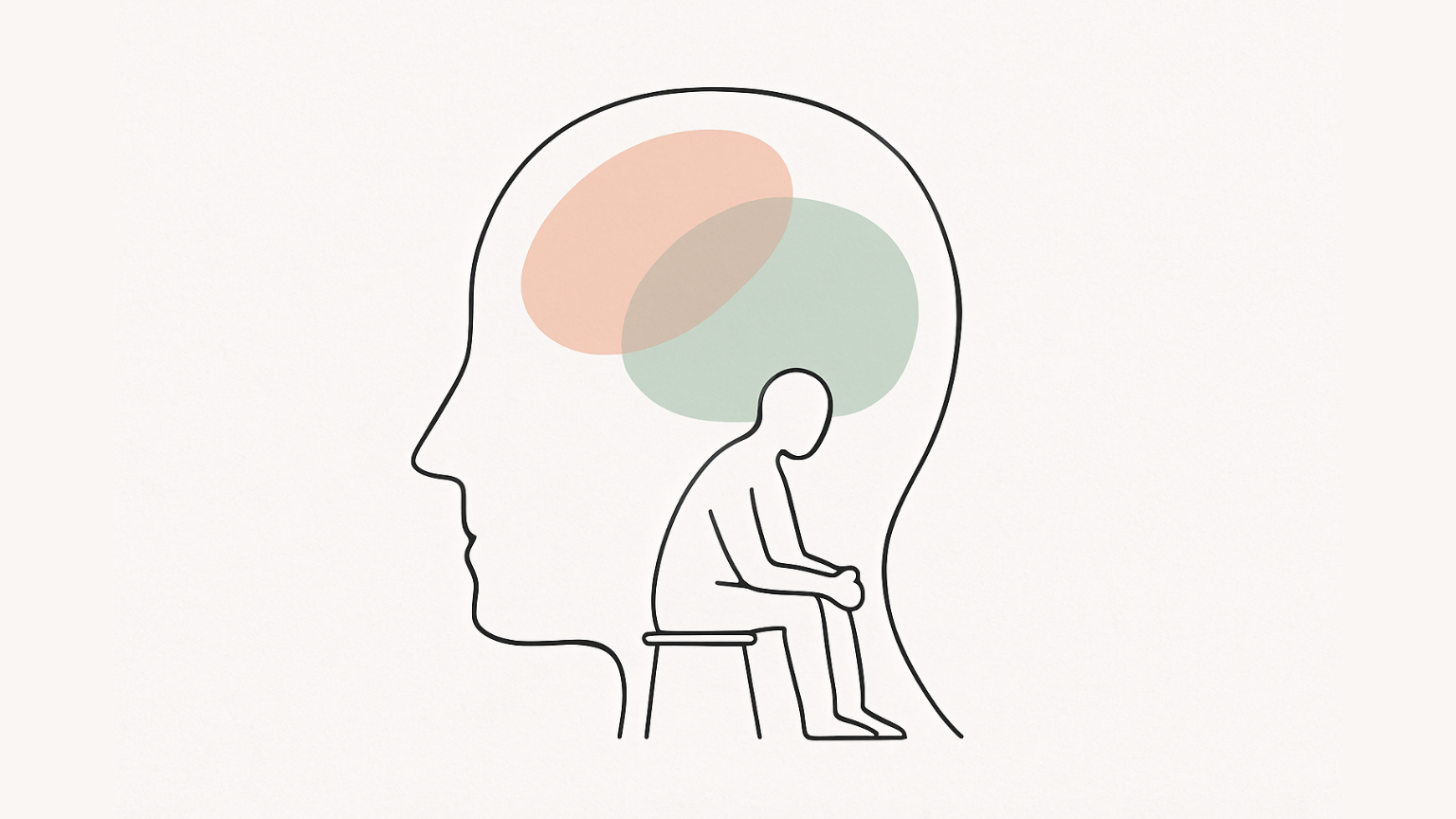
Rumination, decision paralysis, and living in your head.
Your brain just won’t switch off
You’ve replayed that conversation a dozen times.
You’ve run through every possible outcome.
You’ve made a list… then a second list… then abandoned both.
It can feel like your mind is constantly on — scanning for risks, predicting reactions, trying to find the “right” path forward.
And all that thinking? It can be exhausting.
Overthinking usually has a purpose
At its core, overthinking is protective.
It often begins as a way to stay safe — to avoid getting it wrong, upsetting someone, or being caught off guard.
You might have learned early on that being prepared meant being okay.
That being “easy” or “right” was how you kept the peace.
That the best way to avoid pain was to anticipate it.
So your mind learned to get ahead of everything — just in case.
But instead of creating certainty, it often creates stuckness
You might get caught in:
- Looping thoughts or replaying old situations
- Paralysis around decisions – even small ones
- Second-guessing your feelings or instincts
- A constant sense of pressure to get it right
The harder you try to think your way through, the more tangled it can feel.
And when every decision feels high-stakes, it’s easy to get stuck in analysis paralysis — where the fear of choosing “wrong” keeps you from choosing at all.
Overthinking and the anxiety cycle
When something feels uncertain or uncomfortable, it’s natural to reach for reassurance — from yourself, from others, or from endless Googling or mental checking.
And while that reassurance might help for a moment, it rarely sticks.
Instead, it can become part of an anxiety cycle:
Worry → Seek relief → Temporary calm → Doubt returns → More worry…
In therapy, we look at this cycle gently — not to criticise or “fix” it, but to understand how it works, and what might help soften its grip.
Not every thought deserves a microphone
One of the trickiest parts of overthinking is that thoughts often feel factual — even when they’re not.
You might find yourself caught in:
- All-or-nothing thinking (“If I can’t do it perfectly, I’ve failed.”)
- Catastrophising (“If I say the wrong thing, they’ll never speak to me again.”)
- Mind-reading (“They probably think I’m annoying.”)
- Shoulds and self-criticism (“I should have handled that better.”)
These are what CBT often calls cognitive distortions — habitual ways of thinking that can sound convincing, but don’t always reflect the full picture.
In therapy, we begin to notice these patterns — not to dismiss or invalidate your thoughts, but to hold them with more curiosity and kindness.
You don’t have to fight your mind — but you can relate to it differently
Rather than trying to silence every thought, therapy can offer tools for responding in new ways.
This might include:
- Mindfulness practices that help you come back to the present
- Gentle body-based tools to settle the nervous system
- Learning to observe your thoughts without becoming entangled in them
- Using self-compassion instead of self-blame when spirals happen
- Exploring what it means to move forward without full certainty
You don’t have to control every outcome.
You don’t have to think your way into peace.
Sometimes, the shift comes from learning to feel safer in uncertainty — and from trusting that you’ll be able to handle what comes.
In therapy, we can untangle this together
Overthinking can feel like a tangled ball of yarn — one you’ve been trying to unravel on your own for a long time.
Therapy doesn’t promise instant clarity.
But it does offer:
- A place to hear yourself think out loud
- A calm presence to help you slow down
- Support in making sense of what matters to you
- Gentle encouragement to move from stuckness into choice
You don’t need to figure everything out before you begin.
Just showing up is the first step.