
The invisible “rules” we learn about what makes us lovable or acceptable — and how they still shape us as adults.
You Were Never Meant to Earn Your Worth
At some point, many of us quietly absorb a message: that we’re only okay — only lovable, acceptable, or safe — if we’re a certain way.
These invisible rules may tell us that we need to be, for example:
- Kind.
- Helpful.
- Productive.
- Successful.
- Calm.
- Easy to be around.
We might not remember when we learned this and the likelihood is that no one sat us down and explained it in such outright terms. But over time, the message sinks in:
You’re only worthy if…
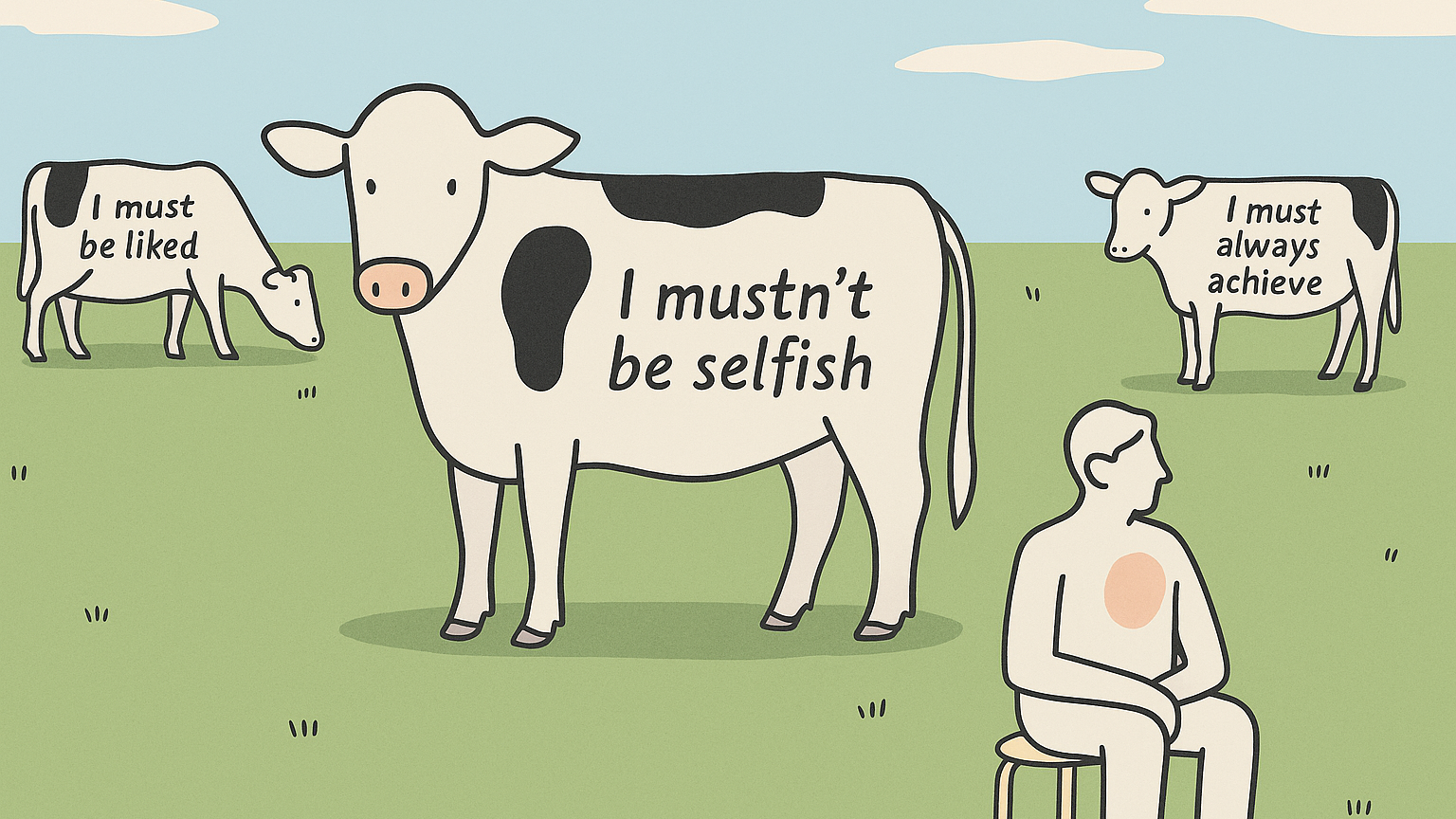
In therapy, we often call these kinds of messages Conditions of Worth — or, COWs for short (to keep it light, and to give us something memorable to spot and challenge!).
These aren’t beliefs we consciously chose. They usually started as our best attempt at staying connected, accepted, or emotionally safe — especially if we grew up in families or systems where love or approval felt conditional. So we learned to shape ourselves accordingly. To overfunction. To suppress the parts of us that didn’t “fit.”
Take this small example…
Someone grows up in a family where she is always praised for being “the sensible one” — calm, self-contained, never making a fuss. Over time, they might begin to believe that showing emotion is risky. That if they cry, get angry, or say how they really feel, they’ll upset people — or worse, be seen as “too much.” So they push feelings down. And they keep pushing, even when no one’s asking them to anymore.
We all carry some version of similarly quiet, internal “rules” that once kept us safe but now keep us stuck.
What we’re about to do is explore where these invisible rules come from, how they still shape us, and what it might feel like to start letting go of them — to live with fewer conditions… and more space to just be yourself, fully.
Where Do These “Rules” Come From?
No one hands us a rulebook.
But we start writing one, early on.
Sometimes it’s obvious:
“Be good.” “Say thank you.” “Don’t talk back.”
Other times, it’s subtle — a look, a reaction, a shift in the mood.
And slowly, we start to internalise quiet rules like:
- Be helpful → don’t have needs
- Be smart → don’t fail
- Be easygoing → don’t be too much
These kinds of beliefs often take root in childhood. They’re shaped by all sorts of things:
- What our families praised or punished
- Messages from school, religion, or culture
- What got us attention from friends — or what got us teased
- The roles we slipped into without meaning to
- The things we felt we had to hide, to stay safe or keep the peace
This isn’t about blame.
Most of the time, people were just doing the best they could. But kids are sponges.
We absorb what gets us connection — and we avoid what doesn’t.
Underneath it all, it’s not just about approval.
It’s about safety. And belonging.
Here’s how those old rules might still be showing up:
- A child praised for being “low-maintenance” might learn to suppress their needs.
- A teen called “too sensitive” might start hiding their emotions.
- A kid who only got attention when achieving might link their worth with performance.
To aid your own reflections, a helpful prompt might be:
“What did I learn I had to be — or not be — in order to feel accepted or valued?“
And, of course, when we grow up, these beliefs don’t just disappear. Often, they just go underground — shaping the way we talk to ourselves, the choices we make, and how we show up in the world.
You can think of them as the base of the iceberg — mostly hidden, but integral to what is above the surface.
How They Show Up Now
When we grow up, we don’t just leave these beliefs behind with our childhood bedrooms.
The people or places that shaped them may no longer be present, but the internal “rules” often stick around.
They show up in our inner voice.
In the way we respond to others — especially when we’re stressed, tired, or feeling vulnerable.
And in the habits that feel automatic… but not always helpful.
A quick example…
Imagine someone who always prides themselves on being the “go-to” friend — reliable, thoughtful, always available.
Over time, this person starts to feel burnt out. Even resentful. Any time they think about setting a boundary or saying no, a familiar voice kicks in:
“Don’t be selfish. They’ll think you don’t care.”And, logical or not, this feels real… Very real.
These kinds of internal rules can show up in all sorts of ways, like:
- Struggling to rest or slow down without guilt
- Feeling responsible for everyone else’s emotions
- Over-apologising or overexplaining
- Equating your worth with how productive, useful, or successful you are
- Avoiding conflict — especially if anger feels dangerous
- Feeling anxious or ashamed when you’re not being helpful or liked
- An inner critic that turns up the volume anytime you fall short
You might not walk around thinking,“I must achieve to be lovable”, but the feeling creeps in anyway when you slow down, make a mistake, or try to do less.
This isn’t about weakness.
It’s about wiring.
These beliefs often operate just below awareness — not always loud, but quietly steering how we live.
Your brain isn’t being difficult — it’s doing what it learned would keep you safe. It’s not necessarily serving you well anymore — but, in a world where survival is our brain’s primary concern, it does make perfect sense.
At times, it can feel like your mind is still following an old rulebook — one that helped you survive the early chapters, but doesn’t match the story you’re trying to live now.
Try asking yourself:
“What’s something you often feel like you ‘should’ be doing — even when no one’s actually asking you to?”
Uncovering the old rules that still silently guide us is a key step towards understanding “How your past is still present”, and how you might begin loosening the things that still keep you tethered…
You Can’t Heal What You Can’t See
Remember the ‘Iceberg’ metaphor? With our core beliefs sitting at the base – not always visible but always very much there, quietly shaping our life in ways we don’t always see at first… How we speak to ourselves, what we feel allowed to want, what we believe we deserve…
The first step towards change is getting a good look at what sits at the base of this iceberg – for you.
Because once you see it — really see it — things can really start to shift.
It won’t instantly dissolve, but you may feel its grip loosen just a little.
Such is the power of self-awareness: knowing yourself and being empowered to make different choices that better serve you… A fantastic place to start!
This idea of past experiences giving rise to learned beliefs that quietly impact our present-day lives (often unnoticed) is a powerful one, and most therapeutic approaches have something to say about it…
Person-Centred / Humanistic Therapy:
This is where the term Conditions of Worth originally came from — Carl Rogers’ idea that we only feel lovable or acceptable when we meet certain standards set by others.
Cognitive Behavioural Therapy (CBT):
Uses the language of core beliefs — deep, often unspoken rules about the self, others, and the world.
Schema Therapy:
Describes similar patterns as early maladaptive schemas related to unmet emotional needs in childhood — like unrelenting standards, self-sacrifice, or defectiveness/shame.
Internal Family Systems (IFS):
Might see these “rules” as beliefs held by certain parts — like striving parts, pleasing parts, or protective managers — all working hard to keep us safe from harm or shame.
Whichever starting point we choose in the quest to better understand ourselves, one truth holds:
You’re not broken.
You just learned a story that might need an update.
To be clear, this is not about overhauling your whole identity – and, again, any conditions of worth you hold won’t suddenly go away once you name them.
But therapeutic work often begins with just noticing — catching one of these thoughts “mid-sentence” and asking,
“Hang on… where did that come from?“
With that awareness comes new choice — the chance to gently notice what’s been driving you, bring it into the light… and then use this self-awareness to help you live your best life as your true self.
From Earning to Belonging
Worth isn’t something you earn.
It’s something you already have — even if no one ever taught you that.
The internal rules you’ve been following — the ones that whisper be helpful, stay calm, don’t mess up — were never really about being your best self.
They were about being acceptable.
Being safe.
Fitting in.
But acceptance isn’t the same as belonging.
Belonging means you don’t have to prove, perform, or shape-shift to deserve connection.
You just get to be you as you truly are. Messy, growing, still figuring it out — and still worthy of love, support, and rest.
Here’s a gentle reframe to sit with:
“What if you didn’t have to earn it anymore?”
“What if you were never supposed to in the first place?”
In therapy, this kind of shift doesn’t happen all at once.
But with time, it might begin to look like:
- Gently noticing and naming your inner critic
- Practising self-compassion (especially when it feels unfamiliar)
- Learning to sit with the guilt or anxiety that shows up when you stop following an old rule
- Updating your self-talk from “I have to…” to “I’m allowed to…”
You could maybe think of it a little like retiring an old operating system.
It got you through a lot — no doubt about that.
But maybe now, it’s time for an upgrade: one that runs on your values, not your fears.
Again, this isn’t about becoming a different person.
It’s about becoming more You — the version of yourself that has never needed to earn their place.