A simple, down-to-earth look at what therapy actually involves.
We begin wherever you are
If you’ve never had therapy before, it’s normal to feel unsure about what to expect. You might wonder:
“What do I talk about? Will I be analysed? Will they just sit there in silence?”
Here’s the thing — you don’t need to have a plan or the right words. You just need to show up as you are. From there, we can begin.
It’s more of a conversation than you might expect
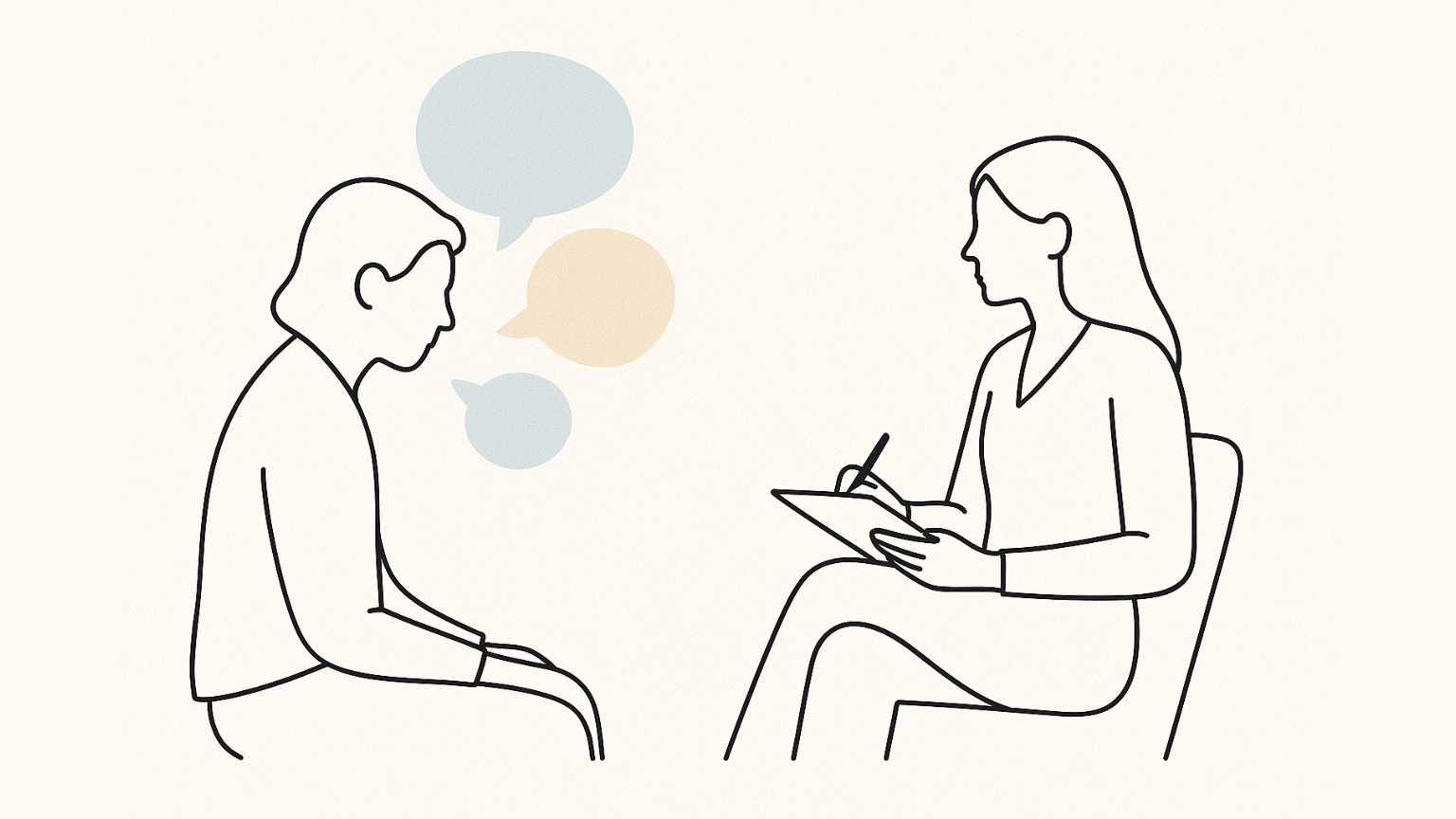
A typical session is more like a calm, open conversation. You’re invited to talk about what’s been going on, what’s felt heavy, or whatever’s on your mind that day.
Sometimes it’s a recent situation.
Sometimes it’s a pattern you’re noticing.
Sometimes it’s just a feeling that something isn’t quite right.
And if you’re not sure where to start? That’s okay. We’ll find the thread together.
What a therapist actually does
Different therapists work in different ways, but generally speaking:
They listen closely, without judgment or interruption
They ask questions to help you understand yourself more deeply
They reflect things back, so you can hear yourself more clearly
They may sometimes offer tools or perspectives, if that feels helpful
They don’t give advice, analyse your every word, or try to ‘fix’ you. The goal is to make sense of things together — at your pace.
The first session might feel a bit different
Your first session may include a little more structure — things like going over confidentiality and boundaries, hearing more about what’s brought you here, and gently exploring what you’d like from the space.
It’s okay to be nervous.
It’s okay not to know your goals yet.
There’s no pressure to “perform.”
And over time…
You might begin to notice:
You feel a little more grounded after sessions
You start to recognise patterns that once felt automatic
You feel less alone in what you’re carrying
Things begin to feel a bit more manageable
You don’t have to do it alone
Therapy isn’t about changing who you are. It’s about having space to explore, untangle, and feel more like yourself again. Or to feel more at ease in your own skin – for what may even be the very first time.
Reassurance that showing up unsure is a completely valid place to begin.
Not everyone comes to therapy with a name for what they’re feeling
Some people arrive with a clear issue in mind. Others come carrying something heavy and hard to explain — just a sense that something’s not right.
You might be feeling stuck, foggy, exhausted, tearful, irritable, numb — or some blend of all of it.
It’s okay if your thoughts feel unclear. You don’t have to lay it all out neatly. This isn’t about presenting a polished version of what you’re feeling — it’s about giving those feelings space to be seen and heard.
Therapy doesn’t always begin in a straight line
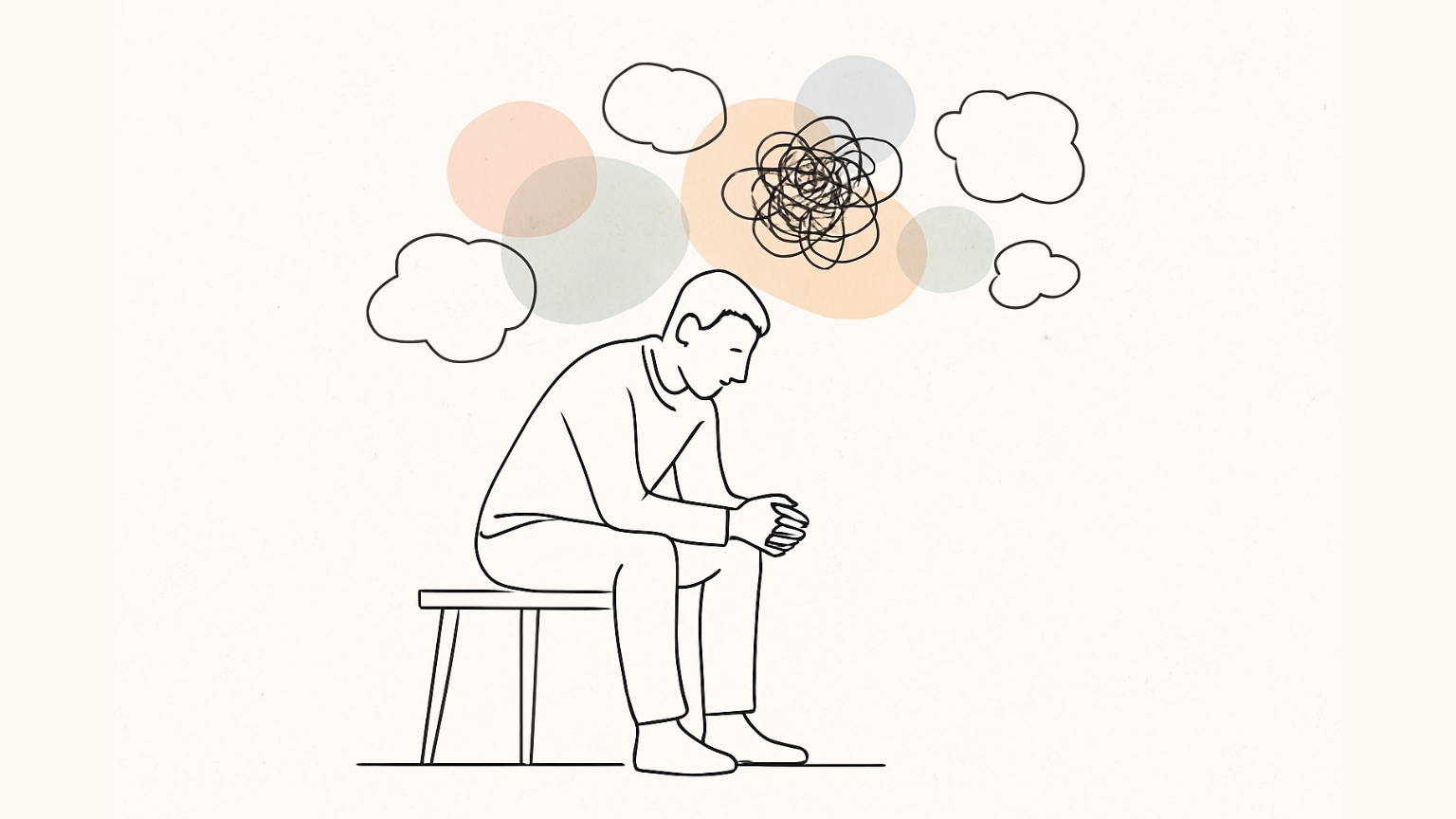
If you’ve been holding things in for a long time, they might come out in fragments. Or in a jumble. Or not at all, at first.
That’s what therapy is for.
You don’t need to worry about saying the right thing. We can sit with what’s there and make sense of it together — piece by piece, in your own time.
A few places you might begin…
You could start by sharing:
What’s been feeling heavy lately
A pattern you’ve noticed but don’t understand
Something you keep circling back to
What it was that made you reach out now
Or we can simply begin wherever your thoughts take you in the moment. No pressure. No wrong way.
You don’t need to untangle everything to be heard
If you’re showing up, that’s enough. We can work with fragments. We can follow the threads. We can sit in silence, if that’s what’s needed.
Therapy is about meeting yourself — not getting it right.
What to do with the doubt that your problem isn’t “serious enough.”
“Other people have it worse…”
… Maybe you’ve had this thought. Maybe you’ve even typed out a message to a therapist — then deleted it, thinking:
“This probably isn’t a big enough deal.” “I’m just being dramatic.” “Other people go through worse.”
Here’s the truth:
Suffering doesn’t always look the same. One person’s pain might be loud and visible; another’s might be quiet and persistent. Neither is more or less valid.
A toothache and a bellyache hurt in different ways — but both hurt! And both deserve care.
You don’t need to be in crisis for therapy to be worthwhile. There’s no threshold you have to cross before reaching out.
You’re allowed to take up space
You don’t need a diagnosis or a life-shattering event to start therapy. Sometimes what brings people in is a quieter sense that something feels off — that life is harder than it should be, or that you’re not quite okay, even if things “look fine” on the outside.
You might be navigating:
A build-up of stress or worry that won’t switch off
Big feelings about something others might see as “small”
A loss that isn’t officially recognised (like a friendship shift, missed opportunity, or change in identity)
A pattern you keep falling into, even though you want to change it
None of these things have to be “justified” to matter.
If it matters to you, it matters
Sometimes what we carry is small but relentless. Sometimes it’s a tangle of feelings with no clear label. Sometimes we just feel… not quite ourselves.
Whatever it is — if it’s sitting on your chest or circling your thoughts — you’re allowed to bring it in.
Talking about it won’t make it bigger. But it might make it lighter.
And: Therapy can also be about moving towards something
It doesn’t always have to begin in pain. Sometimes people come to therapy because they want more clarity, more confidence, more space to understand themselves. To feel more like themselves again — or maybe for the first time.
You don’t need to be falling apart to want something different. You just need to be curious about what could shift — and willing to take a step towards it.
Therapy is a space for everything that’s hard to carry alone
You don’t need to “qualify”. You don’t need to explain why it hurts. You don’t need permission.
If something’s nudging at you — or if this post feels a little bit like it’s describing you — you’re probably in the right place.
A quiet reminder that up-and-down is still forward.
“I thought I was doing better…”
… At some point in your therapy journey, this thought may occur to you. You’ve had a few good days. Things start to feel lighter. Then suddenly — a hard moment, an old pattern, a wave of doubt. And it can be tempting to think:
“This isn’t working.” “I’m back to square one.” “Why can’t I just hold onto the progress I made?”
That can feel disheartening — but it’s actually a really common part of the process.
Therapy is rarely tidy
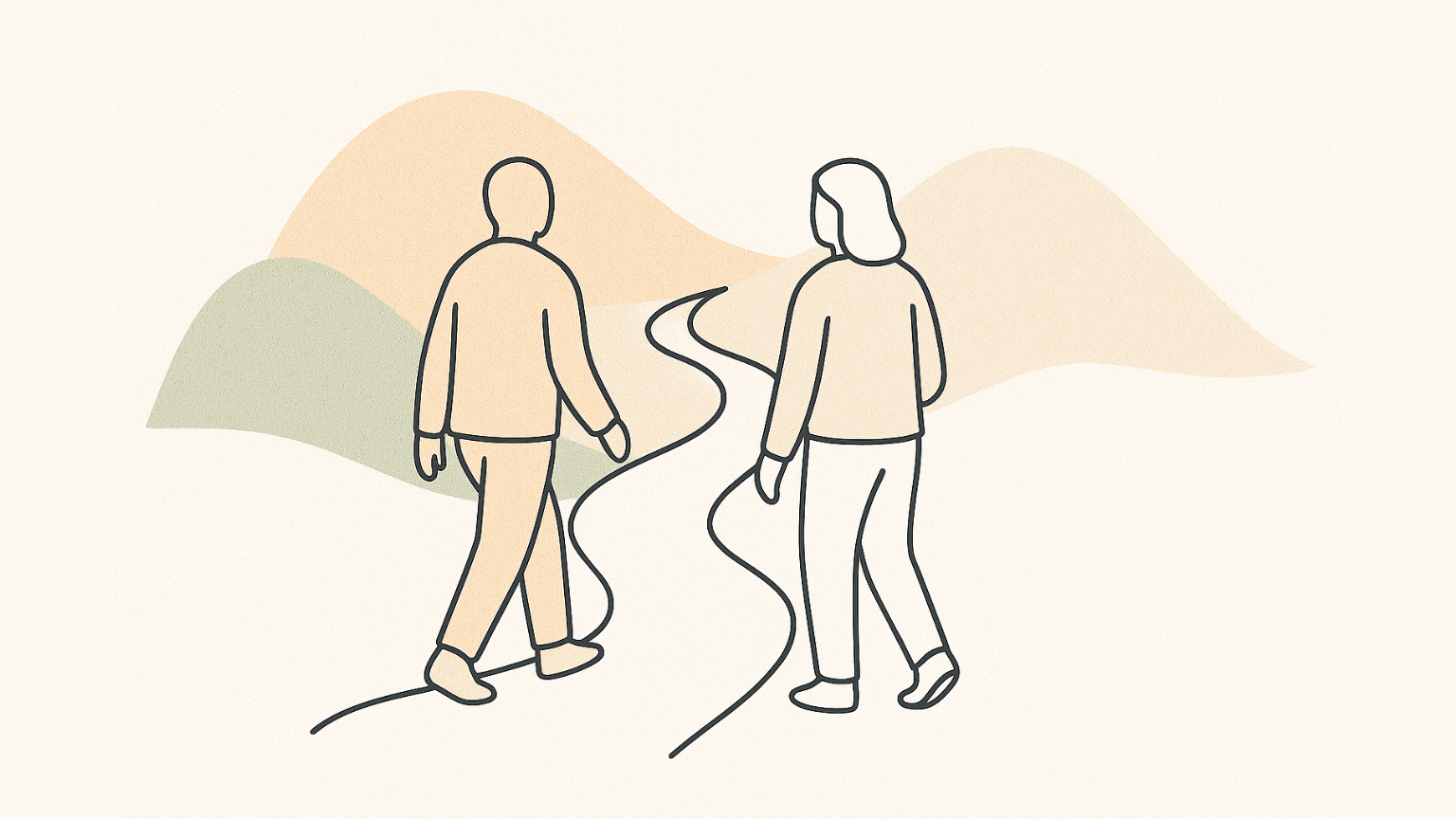
There’s no straight-line graph for healing. Progress often looks like two steps forward, one step back. Or like circling around the same theme a few times — each time with a little more awareness or strength than the last.
Sometimes we revisit something we thought we’d already “solved.” That doesn’t mean you’re failing. It means you’re deepening.
Like climbing a mountain…
Therapy isn’t a smooth path — it’s more like climbing a mountain with uneven terrain. Some stretches are steady. Some are steep. Sometimes you stumble, or slide back a little.
But that doesn’t mean you’re not progressing.
Each stumble tells you something about the terrain — and next time, you might spot the loose rock sooner, or take a steadier step.
You’re learning as you go.
Change doesn’t always feel like change
Some of the biggest shifts don’t come with a fireworks moment.
They show up as small internal nudges:
Responding differently to something that would have overwhelmed you
Taking a breath instead of spiralling
Feeling more able to say no, or yes, or “I don’t know yet”
That might not feel like progress at first glance — but it matters.
Your sessions don’t need to feel profound to be working
Some sessions might bring clarity or release. Others might feel slow, frustrating, or like you’re rambling in circles.
But showing up — especially on those days — is progress. It means you’re making space for yourself. It means you’re doing the work.
You’re not going backwards — you’re moving through
Healing isn’t a performance. It’s a process. And like any process, it has edges and dips and quieter stretches.
With this in mind: The wobbles are fine – they’re just part of the work.
A few words on fit, feedback, and why therapy should feel like the right space for you.
It’s okay to care about the vibe
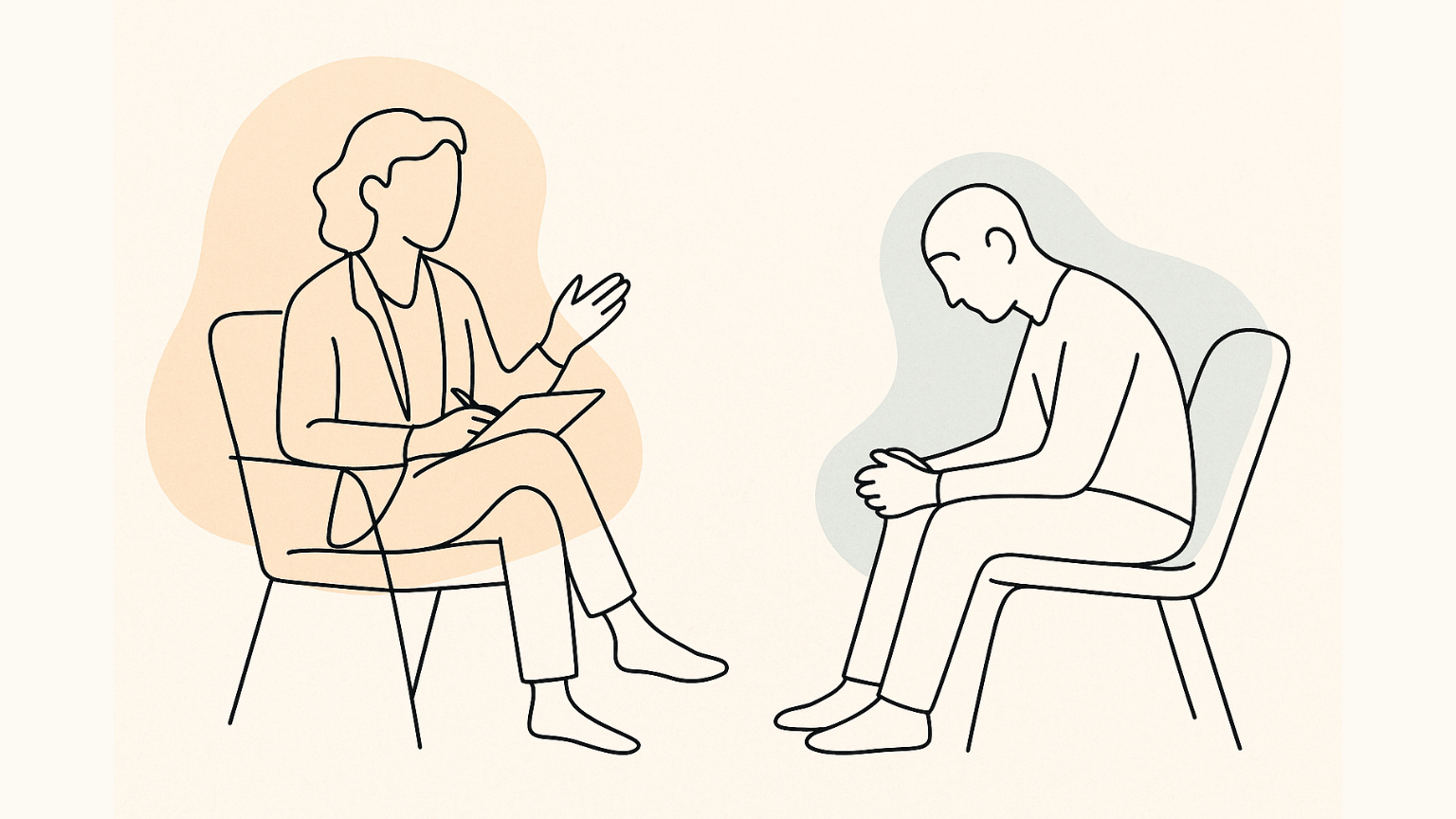
Therapy is a very human thing. You’re not just looking for qualifications — you’re hoping for a sense of connection, understanding, and ease.
You don’t have to justify wanting to feel comfortable. It’s valid to care how it feels to sit with someone — whether that’s over video, phone, or live chat.
The feel of therapy matters
Sometimes therapy feels helpful from the start. Sometimes it takes a few sessions. It’s also okay if you notice the tone, pace, or structure doesn’t quite match what you need.
Therapists work differently. Some are more structured, others more reflective. Some move fast, others take their time. What matters most is whether you feel met in a way that suits you.
Feedback is always welcome
A good therapist won’t expect you to shape yourself around their way of working. They’ll be open to hearing what’s helping — and what’s not — so the work can shift and grow with you.
That’s how I try to work, too. I’ll regularly check in with you, not just about what we’re exploring, but about how the process feels. If something isn’t landing, we’ll talk about it. If something feels helpful, we’ll notice that too.
You deserve therapy that fits
Therapy isn’t fixed — it can evolve. If the way we’re working ever starts to feel off, we can talk about it and adjust together. Sometimes that means slowing down. Sometimes it means changing focus. Small shifts can make a big difference.
You don’t need to shape yourself around the therapy — we’ll shape the therapy around you.
An overview of four key areas where anxiety resides – and can be worked on in therapy.
We meet your anxiety where it is
If you’ve ever felt anxious, chances are you’ve heard some well-meaning advice:
“Just breathe.” “Think positive.” “Try yoga!”
And maybe you’ve tried some of it — and found that while some things help, others don’t even seem to scratch the surface.
That’s because anxiety isn’t one dimensional – and neither are the ways we work with it.
We often think of anxiety as a problem to get rid of. But anxiety is actually a built-in safety system, designed to protect us. It’s the adrenaline surge when you step into a road and hear a car coming. It’s what helps you slam the brakes, jump out of the way, or speak up when something’s not okay.
In other words — anxiety can be useful. The goal isn’t to eliminate it completely (and even if we could, that wouldn’t actually be in your best interest). The goal is to understand how it works, and learn how to respond in ways that help you move forward, instead of getting stuck.
Anxiety shows up differently for different people. For some, it’s an endless loop of ‘what-ifs’ and worst-case scenarios. For others, it’s a racing heart, a knotted stomach, or a strong urge to avoid. And for many, it’s all of the above — a mix of anxious thoughts, uncomfortable feelings, physical tension, and habits that keep the cycle going.
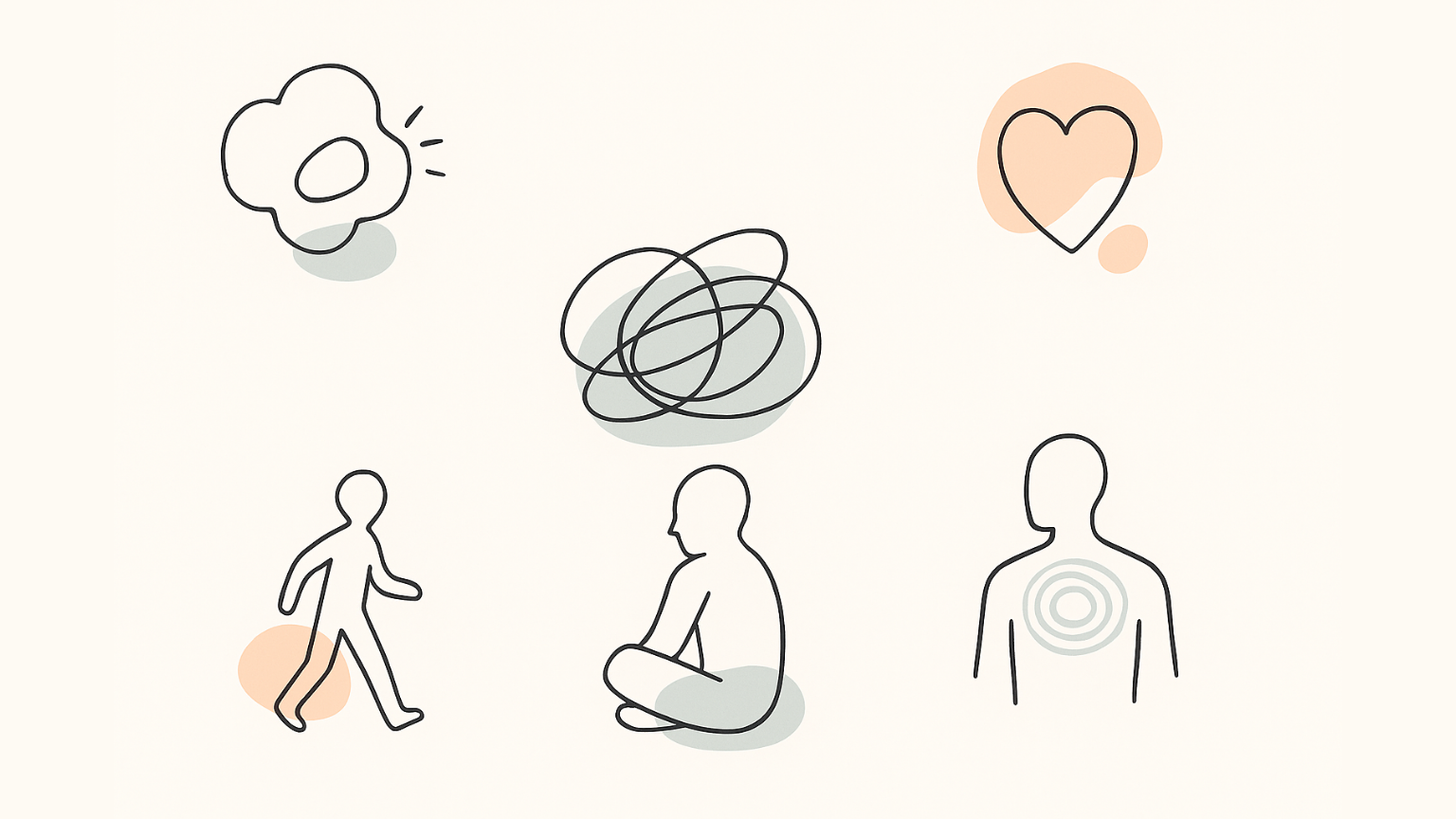
In therapy, I often talk with clients about anxiety using these four key areas — or paths — where we can intervene:
Thoughts – how we work with anxious thinking
Emotions – how we sit with difficult feelings
Actions – what we choose to do (or avoid)
Body – how we respond to anxiety physically
Each of these domains gives us a slightly different entry point. You don’t need to “work on everything” all at once…
In fact, if we can shift things in just one of these areas, we often start to soften the hold anxiety has on us. Sometimes, a small change in one domain can interrupt the whole loop.
That’s why I often say to clients:
“There are lots of ways we can approach anxiety. Let’s figure out what actually fits for you.”
This page serves as an introduction for the Making Sense of Anxiety (In Therapy) series — a set of informative posts designed to give you a clearer picture of what anxiety work can look like in therapy (or on your own).
If you’re already working on your anxiety in therapy — or thinking about starting — this series may help to give you a sense of the kinds of things we can focus on together. And if you’re working on your own, hopefully this can serve as a reminder that you have more tools — and more choice — than it sometimes feels.
Exploring ways to challenge anxious thoughts and how we might improve our relationship with them.
Anxiety often starts in the mind…
When anxiety kicks in, the mind often goes into overdrive.
What if this happens? What if that goes wrong? What if I can’t cope?
And just like that, we’re not responding to what’s happening now — we’re mentally time-traveling into an imagined future; reacting to all the possible disasters our brains can come up with.
And while anxious thoughts might feel automatic, repetitive, or completely out of our control, how we respond is absolutely within our control.
In this section, we’ll look at two main ways we can work with anxious thinking:
Challenging the thought itself (What’s the evidence? Is this helpful?)
Changing how we relate to the thought (Letting it be there without getting pulled in)
Both approaches can be effective — and many people find that a mix of the two is most helpful. The goal isn’t to win an argument with your anxiety. It’s to step out of the loop it keeps dragging you into.
1. Challenging Thoughts
Not every anxious thought is true — but they do tend to feel convincing. That’s because the anxious brain is constantly scanning for problems, then throwing out predictions, warnings, or worst-case scenarios in an attempt to protect us.
Sometimes those thoughts are based on past experiences:
“Last time I did this, it went badly… it’ll probably go badly again.”
Which brings me to one of my favourite sayings from Cognitive Behavioural Therapy (CBT):
“The past doesn’t equal the future.”
The Brain Loves Shortcuts (Even When They’re Unhelpful)
The brain is wired to learn from danger. So if something once felt threatening — even if it wasn’t — your mind stores that information and starts looking for anything remotely similar. These mental shortcuts can be helpful in genuinely risky situations, but they often backfire with anxiety.
Your mind might shout:
“Don’t go — this feels the same as last time.”
But that “sameness” is often based on emotional memory, not fact.
That’s why we work on challenging the story the mind is telling, especially when it’s based on assumptions, generalisations, or old wiring.
The anxious brain operates on a better safe than sorry logic — if you feel anxious, your mind assumes there must be a threat. So it starts scanning: What’s wrong? What am I missing? Even if there’s no real danger, the brain doesn’t like uncertainty — and the search itself can keep us stuck in the loop.
Common Thought Patterns That Keep Anxiety Going
These are often called cognitive distortions — or ‘unhelpful thinking styles’. They’re automatic thought habits that tend to show up when we’re feeling stressed, anxious, or overwhelmed. They’re not a sign that something’s wrong with you — they’re just the brain’s way of trying to quickly interpret what’s happening.
In fact, a good rule of thumb is:
If you’re feeling something strongly — whether it’s anxiety, guilt, or fear — there’s often a distortion at play underneath.
Some typical cognitive distortions we might explore in therapy include:
Catastrophising – jumping to the worst-case scenario
Mind reading – assuming we know what others are thinking
Fortune-telling – predicting the future as if it’s fact
Black-and-white thinking – “If I don’t do it perfectly, I’ve failed”
These thought patterns often lead to stuck behavioural loops — like overthinking every decision, asking for repeated reassurance, avoiding things altogether, or checking for signs of danger again and again.
The tricky part? These thoughts often feel like they’re helping — like they’re keeping us safe, prepared, or in control. But more often than not, they’re just draining our energy and fuelling the anxiety loop.
Socratic Questioning: Getting Curious Instead of Getting Stuck
When we challenge anxious thoughts, we’re not trying to “think positive” or fake confidence. It’s not about swapping a “bad thought” for a “good one” — it’s about asking better questions that open things up instead of tightening the spiral.
Some people think of this as “putting their thoughts on trial.” That means looking at all sides: the evidence for and against it, the alternative explanations, the missing context. We’re not pretending everything’s fine — we’re just making space for the idea that things might be more balanced, more complex, or less catastrophic than they first appeared.
Some questions we might explore include:
What’s the evidence for and against this thought?
Is this thought true — or just familiar?
Am I reacting to a feeling, or a fact?
If a friend had this thought, what would I say to them?
You might notice that anxious thoughts often come from deeper fears or beliefs — like “I’ll mess it up,” “I can’t cope,” or “I’m not good enough.” These core beliefs can quietly shape the way we interpret events. Part of the work is gently noticing when a surface-level thought might be tied to something deeper — without needing to solve everything all at once.
A Note on Control
One powerful way to defuse anxious thinking is to ask:
Is this something I can control, influence, or neither?
Sometimes anxious thoughts pull us into scenarios we can’t do anything about. If a worry sits outside your sphere of control, the most helpful move might not be solving it — but noticing it, and shifting focus to something you can act on.
Bottom Line
Challenging thoughts isn’t about arguing with yourself or trying to erase anxiety. It’s about learning to pause — to notice what your mind is doing, and to check whether that story is actually helping.
You don’t need to believe every thought. You just need enough distance from it to decide what to do next.
2. Letting Thoughts Be
Some anxious thoughts don’t need to be challenged. They need to be noticed — and left alone.
That might sound strange, especially if you’re used to trying to fight off every worry or reframe every spiral. But sometimes, the most helpful move is to let the thought be there without reacting to it, believing it, or getting into a debate.
Your Brain Means Well (Even When It’s Loud)
Anxiety often comes from a protective place. Your brain is trying to help you avoid danger — physical, social, emotional, or imagined. It’s working hard to keep you safe, even if it’s overfiring or misreading the situation.
This is where a simple mindset shift can be powerful:
“Thank you, brain, for looking out for me. But I’ve got this.”
You’re not ignoring the thought — you’re acknowledging it with kindness and choosing not to give it the microphone.
This approach is sometimes called cognitive defusion — learning to notice a thought as just a thought, not a truth, and not a command.
It can help to play with the thought a little — to take it less seriously. Some examples people find useful:
Passengers on the Bus – Imagine your thoughts as noisy passengers, shouting directions while you’re driving. You don’t have to argue with them — and you’re not about to kick them off — but you can choose not to take their advice. Just keep driving.
Silly Voice Technique – Repeat the thought in a cartoon voice (think: your inner critic sounding like Homer Simpson).
Pop-up Windows – Picture your thoughts as annoying browser pop-ups. Click the little cross and keep going.
Change the Font – Visualise the thought written in sparkly bubble letters, Comic Sans, or rainbow colours — just enough to shift how seriously you take it.
These may sound a little ridiculous — but that’s the point. You’re loosening the grip. When a thought loses its authority, it loses its hold.
Giving Thoughts Space (Mindfulness, Observation & Reframing)
It can feel natural to try and “solve” every anxious thought the moment it appears. But that often just feeds the cycle — it sends the message that this thought must be important, or dangerous, or urgent.
Mindfulness teaches a different approach: Noticing the thought, without needing to respond to it.
That doesn’t mean ignoring it or pushing it away. It means observing it as a mental event — like a cloud drifting by, a pop-up notification, or background noise. Something you can notice… without needing to act.
You might catch yourself thinking:
“There’s that same old worry again.”
“My mind is doing that thing it does when I’m tired.”
“Ah, here comes the ‘what if’ voice.”
That kind of awareness is the whole point. It creates space between you and the thought — and in that space, you get choice.
You might find it helpful to shift how you talk to yourself when thoughts show up. Here are some phrases that can help change your internal tone:
“My mind’s having a thought right now.”
“Just because it feels urgent doesn’t mean it is.”
“This is just a story my anxiety tells me.”
“Thanks, brain. Noted.”
These kinds of responses can feel a bit odd at first — especially if you’re used to debating or resisting your thoughts. But with practice, they reinforce a simple but powerful message:
You are not your thoughts. You’re the one observing them.
You don’t need to be in a meditation retreat to start building this skill. A few minutes of mindfulness practice each day — even just noticing your breath, or tuning in while walking or making a cup of tea — can start to change how you relate to your thoughts.
I often signpost clients to some of the many excellent guided audio meditations available online — short, approachable sessions that talk you through exactly what to do. Even five minutes a day can make a noticeable difference in how reactive (or not) the mind feels.
Bottom Line
You don’t always need to challenge, debate, or fix an anxious thought. Sometimes, just noticing it — without judgment or urgency — is enough to lessen its power.
By creating a little space, you remind yourself: “I’m still here. And I’m in charge of what I do next.”
Understanding emotions as something more than just “problems to solve”.
’Riding the Wave’ versus ‘Fighting the Tide’
Anxiety often brings more than just worry. It can show up as dread, shame, fear, guilt, frustration — sometimes all at once. And when emotions feel big or messy, the brain’s natural response is to fix it. Or avoid it. Or numb it.
But here’s the twist:
The more we fight the feeling, the louder it tends to get.
What if, instead of trying to get rid of it, we could learn how to sit with it — and ride it out?
In therapy, we can look at how you might stay present with difficult feelings without being overwhelmed by them – shifting the focus from just “coping” to building the capacity to feel, without reacting or shutting down.
1. Feeling It Without Fixing It
Most of us aren’t taught how to sit with feelings — especially the uncomfortable ones. We’re taught to fix them, hide them, analyse them, or distract ourselves until they pass.
But emotions, even painful ones, don’t usually need to be fixed. They need to be felt.
Emotions as Waves, Not Problems
One way to think about emotions is like weather patterns — they roll in, they peak, and they pass, and sometimes they roll in again… If we try to suppress or outrun them, they often stick around longer. But when we make space to actually feel them — without reacting, judging, or rushing — they tend to move through us more freely.
This might sound simple, but it’s not always easy. Sitting with an emotion means:
Noticing where it shows up in the body
Naming what’s there (e.g. tension, sadness, dread)
Allowing it to be there, even if it’s uncomfortable
Letting go of the urge to “solve” it right away
It’s okay if this takes time. Emotional tolerance is a skill — and it builds slowly, in small moments of allowing.
What Is This Feeling Telling Me?
Emotions aren’t just noise — they’re information. They often show up to point out something that matters.
You can think of emotions as signals about needs:
Negative emotions = a need might be unmet
Positive emotions = a need is likely being met
For example:
Anxiety might signal a need for safety, clarity, or reassurance
Anger could reflect a crossed boundary or a sense of injustice
Sadness might point to a need for connection, comfort, or rest
Guilt could signal a conflict with your values
So one way to sit with an emotion is to get curious about it:
“What might this feeling be trying to tell me?” “Is there a need underneath this?”
You don’t have to immediately meet that need, or act on the feeling — but simply naming what’s going on underneath can help soften the urgency.
Slowing the Urge to React
When emotions feel big, fast, or overwhelming, the instinct is often to do something — withdraw, snap, fix, distract, numb. That’s not a failure — that’s just your nervous system trying to protect you.
But even a small pause can change everything.
Next time a strong emotion shows up, you might try saying to yourself:
“This feeling is allowed to be here.” “I don’t need to do anything with it right this second.” “It won’t stay this intense forever.”
Creating a little space between feeling and action is one of the most powerful emotional regulation tools we’ve got — and it’s something you can practice in tiny, everyday moments.
Bottom Line
You don’t have to fix, analyse, or avoid every feeling. Sometimes the most helpful thing you can do is pause, notice, and let the emotion move through.
Feelings are temporary. They don’t need to be solved — just felt.
2. Responding Kindly to Yourself
Anxiety can come with a second wave of struggle — not just feeling bad, but feeling bad about feeling bad.
We beat ourselves up for being too sensitive. We call ourselves silly, dramatic, or weak. We try to “power through” in a way we’d never expect from someone else.
But here’s a quiet truth that changes everything:
You don’t need to be hard on yourself to make progress.
In fact, most people make more lasting change when they feel supported — not shamed — by their own inner voice.
Recognising the Inner Critic
Most of us have an inner critic — that inner voice that shows up when we’re anxious, overwhelmed, or struggling, and says things like:
“Get it together.”
“What’s wrong with you?”
“You’re making a big deal out of nothing.”
“Everyone else can handle this — why can’t you?”
It usually thinks it’s being helpful. It might be trying to toughen you up, motivate you, or protect you from embarrassment. But more often, it just leaves you feeling smaller — ashamed, exhausted, and alone with the struggle.
The inner critic doesn’t make anxiety easier to manage. It makes it louder — because now you’re not just feeling anxious… you’re also feeling bad for feeling anxious.
That’s where self-compassion comes in. Not as the opposite of the inner critic — but as an alternative voice you can choose to listen to instead.
What Is Self-Compassion?
Self-compassion isn’t self-pity. It’s not letting yourself off the hook. It’s not “toxic positivity” or pretending everything’s fine.
It’s about responding to your own difficult moments the same way you might respond to a struggling friend — with honesty, patience, and care.
Dr. Kristin Neff, a leading researcher in self-compassion, describes it as having three parts:
Mindfulness – Acknowledging what you’re feeling without exaggerating or minimising it
Common humanity – Recognising that you’re not alone in this
Kindness – Treating yourself with the tone you’d use with someone you care about
You don’t need to master all three — even a tiny dose of self-kindness can start to shift how you relate to yourself in anxious moments.
Changing the Inner Voice
One way to begin is to notice how you talk to yourself when you’re anxious.
Is it gentle? Or is it punishing? Is it curious? Or is it critical? Is it trying to help you feel safe — or just trying to get you to shut up and get on with things?
Here are a few simple exercises you might try:
How would you speak to a friend?
Most of us find it easier to give compassion to a friend or loved one rather than to ourselves…
Imagine your closest friend or a child you care about comes to you, overwhelmed and panicked…
What would you say to them?
How would your tone sound?
Now: what would it be like to offer yourself even 50% of that same tone?
… You don’t have to go full cheerleader. Even a quiet, steady internal “I’m with you” can take the edge off.
Here are a few gentle phrases that may help. These aren’t magic words — but they can act as anchors in the storm. Try a few on and see what feels good:
“I can be kind to myself, even when I’m struggling.”
“This is hard, but I’m doing my best.”
“Of course I feel anxious — this matters to me.”
“There’s nothing wrong with me for feeling this way.”
“Other people feel this too — I’m not broken.”
Self-Compassion Doesn’t Mean You Have to Like the Feeling
Some people worry that being compassionate will make them passive — or that they’re “indulging” the anxiety. But self-compassion isn’t about liking the feeling. It’s about softening the way you meet yourself in it.
You don’t have to say:
“Yay, anxiety!”
But you can say:
“This is hard… and I can be gentle with myself while I get through it.”
And weirdly, the gentler tone? That’s often what allows the emotion to ease.
Bottom Line
Self-compassion isn’t a luxury or a bonus — it’s part of what helps anxiety loosen its grip.
You don’t have to be fearless. You don’t have to be perfect. You just have to treat yourself like you matter — especially on the hard days.
To finish, I’d like to share this super simple tool you can use in the moment when things feel overwhelming…
The Self-Compassion Pause
When things feel really tough and overwhelming…
Pause – Take a breath. Just notice what’s happening.
Acknowledge – Say to yourself: “This is a moment of struggle.”
Normalise – “Struggle is part of being human — I’m not alone in this.”
Respond kindly – “What do I need right now? Can I offer myself even a little kindness?”
Some people choose to do this exercise with one hand placed gently over the heart.
It only takes a few seconds — but sometimes that’s enough to shift the tone of how you’re meeting yourself.
The role of safety behaviours in maintaining the anxiety cycle, and how values-based choices can help us reclaim space in our lives.
How Anxiety Shapes Our Behaviour – and How Our Behaviour Shapes Anxiety
Anxiety doesn’t just show up in our minds or bodies — it shows up in our behaviour. It shapes the choices we make, the things we avoid, the routines we fall into, and the ways we try to cope.
And the tricky part? A lot of what we do to feel better in the short term (like avoiding, checking, or over-preparing) can actually feed the anxiety over time.
This section is about taking a closer look at that loop — and how we can gently start to shift our responses.
There are two big areas we’ll focus on:
Facing What We Avoid – how to safely, gently approach the things anxiety has taught us to fear
Building Supportive Structure – how small changes in routine, rhythm, and habits can bring a sense of safety and control back online
This isn’t about pushing yourself too far, too fast. It’s about reclaiming your freedom to choose — one small, intentional step at a time.
1. Facing What We Avoid
One of anxiety’s most convincing messages is:
“You can’t handle this.”
And so, naturally, we start pulling back. We avoid the things that trigger anxious thoughts, feelings, or sensations — situations, people, decisions, memories, even parts of ourselves.
In the moment, avoidance brings relief. But over time, it shrinks our lives. It reinforces the belief that certain things are dangerous, or that we’re not capable — even when that isn’t really true.
The Anxiety-Avoidance Loop
Avoidance is often the behaviour that keeps anxiety stuck in place.
Here’s how the loop works:
You feel anxious about something (a situation, a task, a conversation)
You avoid it
You feel a sense of short-term relief
Your brain learns: “Phew. Avoiding that worked — let’s do it again.”
The next time, the anxiety feels stronger, not weaker
So even though avoidance feels protective, it quietly fuels the fear over time. And it stops us from collecting the kind of evidence that challenges it.
Example 1 – Social Anxiety: You feel anxious in social settings, so you start turning down invitations. Each time you avoid a gathering, your anxiety gets some relief — but your brain never gets the chance to find out maybe you could’ve handled it, or even enjoyed it. Over time, the fear of socialising grows — not because it’s dangerous, but because your brain only ever experiences it as a threat.
Or, how about…
Example 2 – Health Anxiety: You notice a strange physical symptom — say, a tight chest or a twitch — and immediately Google it or book another check-up, just to be sure. It eases your anxiety for a while… but then it comes back, often stronger. The brain learns that the only way to feel safe is to keep checking, which locks you into a loop of constant scanning and reassurance-seeking.
Safety Behaviours: The Sneaky Side of Anxiety
Avoidance is one way anxiety tries to protect us — but it’s not the only one. Sometimes we go through the motions of facing a situation, but we lean on subtle strategies to feel “safer” — like distracting ourselves, seeking reassurance, or mentally rehearsing.
These are called safety behaviours, and while they make sense in the moment, they can keep us from really learning that we can cope.
Some common examples include:
Rehearsing conversations in your head over and over
Leaving things to the last minute (in case you “fail” anyway)
Always needing reassurance before acting
Keeping busy so you never have to sit with discomfort
Checking, scanning, researching endlessly
Over-preparing or over-controlling every detail
These aren’t bad — they’re just your brain trying to help. But the more we rely on them, the more we teach the brain that anxiety = danger.
Letting go of safety behaviours — even just a little — helps build confidence in your ability to handle the situation as it is.
The Way Out Is Gently Through
This is where exposure work comes in. Not the dramatic kind — but the small, intentional kind.
Exposure is about relearning safety — by gradually facing the things anxiety has taught us to fear, and discovering that we can handle them more than we realised.
The idea isn’t to throw yourself into the deep end. It’s to create a step-by-step path back into situations you’ve been avoiding — at a pace that’s challenging, but not overwhelming.
One tool we often use for this is called an exposure hierarchy. It’s essentially a list of feared situations or triggers, ranked from least to most scary. You work your way up, one step at a time, building confidence and tolerance along the way.
Example – Simple Phobia: Spiders A person with a spider phobia might build a hierarchy like this:
Look at a cartoon spider online
Look at a real photo of a spider
Watch a short video of a spider moving
Stand across the room from a spider in a jar
Sit next to someone holding the jar
Hold the jar yourself
Let a small spider crawl on your glove
Let it crawl on your bare hand
Each step is repeated until the anxiety begins to ease — and only then do you move up. You’re giving your brain a chance to learn: “This is safe. I can handle this.”
Even tiny steps make a difference.
Anchoring Exposure in What Matters (ACT Lens)
If we’re going to ask our nervous system to do hard things — like stepping toward discomfort — it helps to know why.
In ACT (Acceptance and Commitment Therapy), we often ask:
“What matters to you more than avoiding anxiety?”
Facing fears isn’t just about reducing symptoms — it’s about making space for the life you want to live.
Maybe you’re working on facing your fear of driving — not just to “beat the fear,” but because you want to be free to visit friends or take a road trip again. Maybe you’re saying yes to social plans not to become a party person, but because connection matters to you more than comfort.
Let your values guide your steps. If it’s meaningful, it’s worth doing — even if it’s messy.
A Few Principles That Help:
Start where it feels possible – Not easy, necessarily — but possible.
Expect discomfort – Feeling anxious doesn’t mean it’s wrong. In fact, it means your brain is learning something new.
Stay long enough to let the anxiety rise… and fall – Don’t rush away the second it spikes. Give your brain a chance to experience the full wave.
Do it again — sooner than later – Repetition matters. It’s what tells your nervous system: “This is safe now.”
You Get to Choose the Pace
Facing fears is not about forcing yourself into panic to “get over it.” It’s about reclaiming your choice. You can say, “I’m willing to feel uncomfortable for a little while if it helps me live the life I want.”
And if a step feels too big, you’re allowed to break it down. There’s always a smaller version. There’s always a way in.
Bottom Line
Avoidance is understandable — and also very sneaky. It offers short-term relief, but long-term reinforcement of anxiety.
Facing what we avoid doesn’t mean being reckless or “just doing it” — it means choosing courage in small, doable steps, and slowly reminding your brain what safety feels like.
2. Building Supportive Structure
Anxiety thrives in uncertainty. When everything feels chaotic or up in the air, the brain kicks into survival mode — scanning, second-guessing, over-preparing.
That’s why supportive structure can be such a powerful tool. Not because it “fixes” anxiety, but because it creates little pockets of safety, predictability, and momentum in your day.
Think of it like building scaffolding. You don’t need to control everything — but having a few solid supports in place can make it easier to show up, focus, rest, and breathe.
Routines That Anchor
We’re not talking rigid schedules or military-level morning routines. This is about small, intentional practices that ground you.
A gentle wake-up and wind-down ritual
A few minutes of movement or breathing to reset your nervous system
A regular time each day to check in with yourself, journal, or plan
A soft boundary between “work mode” and “rest mode”
If you’ve ever explored WRAP (Wellness Recovery Action Planning), you’ll know how powerful it can be to name the things that help keep you well, balanced, and on track — before things start to spiral.
A Closer Look: What’s in a WRAP Plan?
WRAP is a simple, flexible framework originally developed by Mary Ellen Copeland. It helps you identify what supports your wellness, what signals you’re starting to struggle, and what helps when you’re in a difficult place.
You don’t need to follow it perfectly — it’s just a tool you can shape around you.
At its core, WRAP is a way of creating a guidebook for your future self — the version of you who might be overwhelmed, anxious, flat, or just off balance. You’re saying:
“Hey, I know things are hard right now, but here’s what helps. Let’s start there.”
It’s mostly the kind of simple, supportive stuff that seems obvious when we’re feeling okay — but tends to go out the window when anxiety ramps up. Putting it down somewhere gives you something to come back to when your mind goes foggy.
Core Parts of a WRAP Plan:
Daily Maintenance Plan What helps you feel steady and well on a day-to-day basis?
Triggers and Action Plan What tends to set off your anxiety?
Early Warning Signs What are the subtle signs you’re beginning to struggle?
When Things Are Breaking Down What does “crisis mode” look like for you?
Post-Crisis Plan Once things settle, what helps you rebuild?
You can write it, record it, draw it — whatever works. The key is: it’s yours. You’re not trying to be perfect. You’re just making a kind, clear map to help you through the tougher days.
(And no pressure to go off and write one right now — this is just to give you a flavour of the kind of thing we could explore and build together in therapy, if and when it feels helpful.)
Gentle Tools for Focus and Follow-Through
Anxiety often makes tasks feel overwhelming or impossible — especially when perfectionism, fear of failure, or decision fatigue creep in.
That’s where structure can help. Not to force productivity, but to remove the friction.
A good strategy for building new habits into your daily routine is Habit Stacking. From James Clear’s work in Atomic Habits, habit stacking is the idea of attaching a new habit to something you already do – for example:
“After I make my morning coffee, I’ll do 3 rounds of box breathing.” “When I brush my teeth at night, I’ll write down one thing that went okay today.” “After I log into work, I’ll take 30 seconds to check in with my body.”
It doesn’t have to be perfect. Just doable. Repeated small actions add up.
Other techniques that some clients find helpful are:
The Pomodoro technique – 25 minutes on, 5 minutes off
The “just 5 minutes” trick – commit to starting for 5 minutes only
Body-doubling – working alongside someone else, even silently
Structure here isn’t a cage — it’s a container. One that holds you while you move toward what matters.
Taking Action in a Way That Works for You
When you’re feeling anxious or overwhelmed, it can be hard to know where to start — or whether you’re doing enough. Sometimes that leads to avoidance, sometimes to burnout.
That’s where a few planning and communication tools can help reduce the guesswork:
SMART Goals
SMART is a way to break goals down into something actually doable:
Specific – What exactly do I want to do?
Measurable – How will I know when it’s done?
Achievable – Is this realistic for me right now?
Relevant – Does this move me in a direction I care about?
Time-bound – When will I do it, or check in on it?
Instead of “I want to get back into exercise,” a SMART version might be: “This week I’ll do a 15-minute walk on Monday, Wednesday and Friday after work.”
Not everything needs to be a SMART goal, but it can help give shape to vague intentions and reduce the anxiety of “Where do I even start?”
Spotlight Tool: Worry Time
Sometimes people hear “structure” and think it means suppressing anxious thoughts. But one of the best ways to reduce anxiety’s grip is to give it a place to go.
Worry Time
Worry Time is a CBT-based technique where you set aside a daily block of time — usually 10–20 minutes — to intentionally worry.
Why? Because constantly trying to push anxiety away tends to backfire. But giving it space can reduce rumination throughout the day.
How it works:
Designate a fixed time and place – e.g. 6:30pm on the sofa
Throughout the day, if a worry pops up, write it down
Say to yourself: “I’ll deal with this at Worry Time.” Then move on
At the designated time, review your list: Some worries may feel less urgent by then; for those that stick, use techniques like thought-challenging or writing out next steps
When the timer ends, gently wrap up and shift gears
Using a strategy such as Worry Time is like parking your worries in a holding bay, rather than letting them tailgate you all day.
This can be a surprisingly effective way to reduce overthinking without suppressing it — especially if your anxiety tends to spiral into “What if…?” mode on repeat.
(And if you’re working on a WRAP plan, Worry Time could be one of those daily maintenance tools you build in — a small routine that helps you feel more in control without needing to be in control of everything.)
Boundaries and Assertiveness
Sometimes structure isn’t just about what you do — but what you say yes and no to.
Anxiety often makes us overextend ourselves, avoid conflict, or say yes when we mean no. Learning to communicate more clearly — with yourself and others — is a powerful form of self-care.
This might look like:
Saying, “I’d love to, but I don’t have capacity this week.”
Taking a pause before giving an answer
Not over-explaining or apologising for your limits
Letting others know what support does help (rather than hoping they’ll guess)
It’s okay if this stuff feels clunky at first — it’s a skill, and you’re allowed to practice.
Bottom Line
Supportive structure isn’t about being hyper-organised or productive — it’s about reducing chaos where you can, so you’ve got more capacity to face what you can’t control.
Sometimes anxiety says: “Everything is too much.” Structure gently replies: “Let’s take it one thing at a time.”
How anxiety lives in the body, and the ways we can soften or even shift it
Anxiety is Your Personal Internal Alarm System
When anxiety hits, it doesn’t always just stay in your head — often times, it’s in your body.
Racing heart. Shaky hands. Tight chest. Sore jaw. Upset stomach. A kind of full-body buzz that says: “Something’s wrong.”
It makes sense — anxiety is your body’s alarm system. It evolved to keep you safe. And when your brain thinks there’s a threat (even if the threat is just a thought), your body kicks into fight, flight, or freeze.
That might mean:
Tension in your muscles (ready to run or brace)
Faster breathing and heart rate (pumping oxygen to limbs)
Sweaty palms (grip and cool down)
Tunnel vision or dizziness (focusing in on danger)
So no, you’re not broken — this is your body trying to protect you. The issue is that it’s doing it a bit too often, or in moments that don’t actually require protection.
It’s Often Hard to Think Your Way Out of a Physical Stress Response
When your body is fired up, logic may not land so well. You might know you’re not in danger, but still feel totally on edge.
That’s because the “thinking brain” tends to go quiet when anxiety spikes — while the body goes into high alert.
In those moments, it helps to try a bottom-up approach — working with the body to send signals of safety, rather than trying to talk yourself down with reason alone.
Just to give you a flavour, here are a few simple, body-based tools I often explore with clients — the kind that can help shift your nervous system out of overdrive.
Breathing That Calms
Breathing is one of the simplest and most effective tools we have.
Here are two tried-and-true techniques I often share with clients:
Box Breathing (Square Breathing)
Inhale for 4 seconds
Hold for 4 seconds
Exhale for 4 seconds
Hold for 4 seconds
…repeat
You can visualise a square or trace it in your mind as you go around the “sides.” It’s simple, grounding, and easy to remember.
4-7-8 Breathing
Inhale for 4 seconds
Hold for 7 seconds
Exhale for 8 seconds
This one’s great for winding down, especially at night — longer exhales help activate the parasympathetic nervous system — the “rest and digest” part of your body’s wiring.
You don’t have to do breathing exercises “perfectly”, and you can feel free to adjust some of the timings to suit your comfort levels. It’s less about the exact numbers, and more about giving your body a chance to slow down and reset.
Progressive Muscle Relaxation (PMR)
Anxiety often shows up as chronic muscle tension — clenched jaws, hunched shoulders, fists, tight legs. Over time, that tension becomes the new normal, and we forget what relaxed even feels like.
PMR is a technique where you gently tense and then release different muscle groups in sequence — working from head to toe or vice versa.
For example: Clench your fists tight for 5 seconds, then slowly release. Notice the difference between the tension and the letting go.
This is a great way to retrain your awareness to notice the difference between ‘tight’ and ‘relaxed’ muscles. It also taps into what’s sometimes called the pendulum theory — the idea that by intentionally tensing a muscle first, you create a kind of swing effect: the muscle naturally rebounds into deeper relaxation after you let go. It’s a simple but powerful way to guide your body out of a wound-up state.
If you suspect you carry a lot of tension in your body, PMR could well be something worth trying — there are plenty of guided PMR audio tracks available online which can be a great place to start.
Grounding Through the Senses
Another body-based way to settle anxiety is through sensory grounding — using your five senses to anchor you in the here and now.
One well-known technique is the 5-4-3-2-1 method:
5-4-3-2-1 Grounding Technique
Concentrate on the present moment; yourself and your present surroundings. In your own time, see if you can name…
5 things you can see
4 things you can touch
3 things you can hear
2 things you can smell
1 thing you can taste
This works by pulling your attention away from the mental spiral and back into your environment — reminding your brain that right now, you’re okay.
Even just noticing the feeling of your feet on the ground or the temperature of the air can be enough to break the cycle.
Gentle Movement to Reset
Anxiety often tells us to freeze — or sit and stew. But movement can be one of the most effective ways to shake off nervous energy.
This doesn’t have to mean a full-on exercise routine — even light, conscious movement can do the trick:
Stretching or yoga
Taking a short walk outside
Shaking out your arms or legs
Rolling your shoulders
Dancing to one song
The point here is, you’re sending your body the message: “We’re not stuck. We’re safe. We can move.”
Bottom Line
Anxiety might start in the mind, but it lives in the body. And when your body gets the memo that it’s safe, things can start to feel a little easier.
So no — you can’t always logic your way out of a spiral. But you can breathe. You can move. You can unclench. You can slow down. And that’s where things often start to shift.