
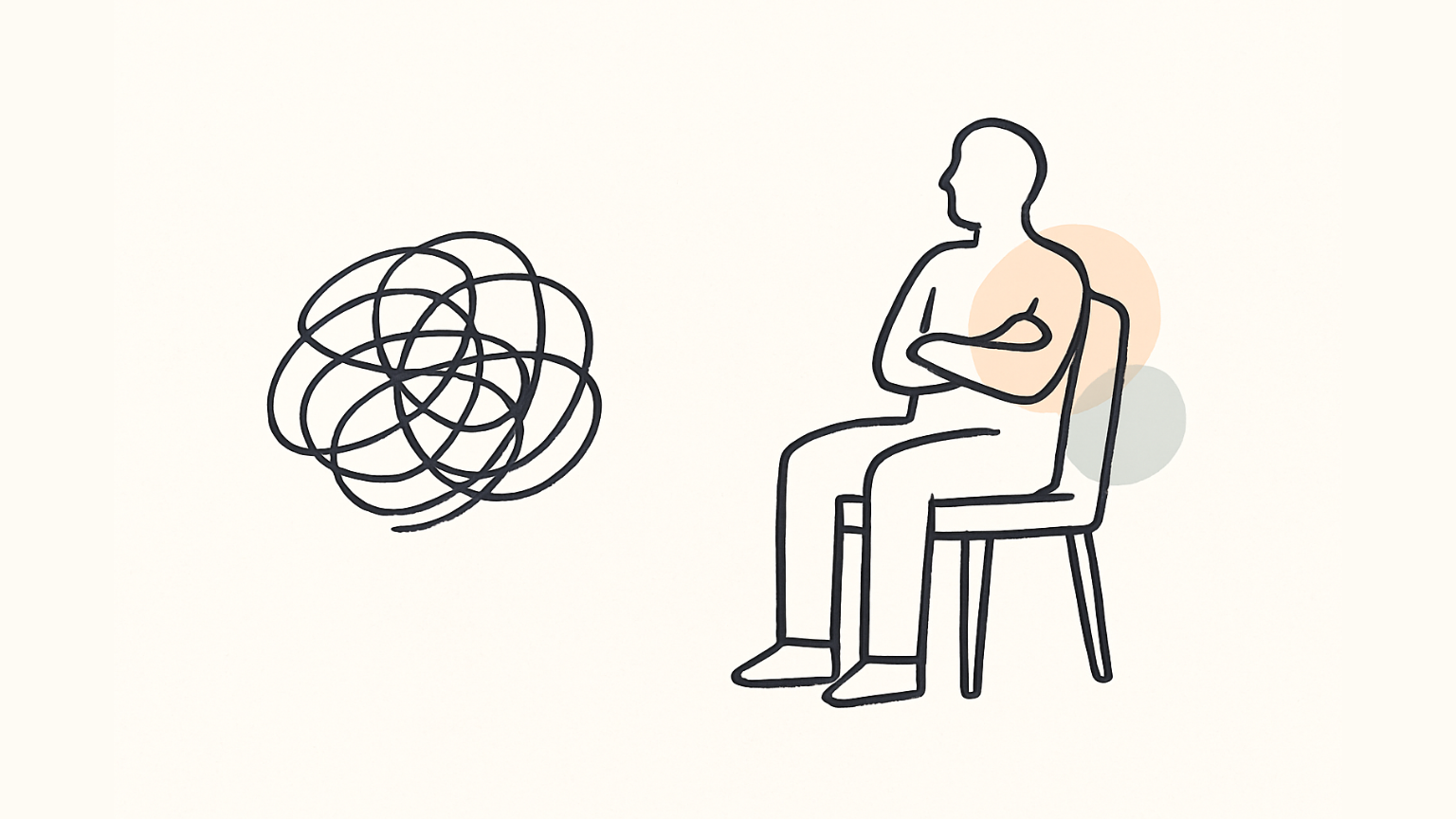
The role of safety behaviours in maintaining the anxiety cycle, and how values-based choices can help us reclaim space in our lives.
How Anxiety Shapes Our Behaviour – and How Our Behaviour Shapes Anxiety
Anxiety doesn’t just show up in our minds or bodies — it shows up in our behaviour.
It shapes the choices we make, the things we avoid, the routines we fall into, and the ways we try to cope.
And the tricky part?
A lot of what we do to feel better in the short term (like avoiding, checking, or over-preparing) can actually feed the anxiety over time.
This section is about taking a closer look at that loop — and how we can gently start to shift our responses.
There are two big areas we’ll focus on:
- Facing What We Avoid – how to safely, gently approach the things anxiety has taught us to fear
- Building Supportive Structure – how small changes in routine, rhythm, and habits can bring a sense of safety and control back online
This isn’t about pushing yourself too far, too fast. It’s about reclaiming your freedom to choose — one small, intentional step at a time.
1. Facing What We Avoid
One of anxiety’s most convincing messages is:
“You can’t handle this.”
And so, naturally, we start pulling back. We avoid the things that trigger anxious thoughts, feelings, or sensations — situations, people, decisions, memories, even parts of ourselves.
In the moment, avoidance brings relief.
But over time, it shrinks our lives.
It reinforces the belief that certain things are dangerous, or that we’re not capable — even when that isn’t really true.
The Anxiety-Avoidance Loop
Avoidance is often the behaviour that keeps anxiety stuck in place.
Here’s how the loop works:
- You feel anxious about something (a situation, a task, a conversation)
- You avoid it
- You feel a sense of short-term relief
- Your brain learns: “Phew. Avoiding that worked — let’s do it again.”
- The next time, the anxiety feels stronger, not weaker
So even though avoidance feels protective, it quietly fuels the fear over time.
And it stops us from collecting the kind of evidence that challenges it.
Example 1 – Social Anxiety:
You feel anxious in social settings, so you start turning down invitations.
Each time you avoid a gathering, your anxiety gets some relief — but your brain never gets the chance to find out maybe you could’ve handled it, or even enjoyed it.
Over time, the fear of socialising grows — not because it’s dangerous, but because your brain only ever experiences it as a threat.
Or, how about…
Example 2 – Health Anxiety:
You notice a strange physical symptom — say, a tight chest or a twitch — and immediately Google it or book another check-up, just to be sure.
It eases your anxiety for a while… but then it comes back, often stronger.
The brain learns that the only way to feel safe is to keep checking, which locks you into a loop of constant scanning and reassurance-seeking.
Safety Behaviours: The Sneaky Side of Anxiety
Avoidance is one way anxiety tries to protect us — but it’s not the only one.
Sometimes we go through the motions of facing a situation, but we lean on subtle strategies to feel “safer” — like distracting ourselves, seeking reassurance, or mentally rehearsing.
These are called safety behaviours, and while they make sense in the moment, they can keep us from really learning that we can cope.
Some common examples include:
- Rehearsing conversations in your head over and over
- Leaving things to the last minute (in case you “fail” anyway)
- Always needing reassurance before acting
- Keeping busy so you never have to sit with discomfort
- Checking, scanning, researching endlessly
- Over-preparing or over-controlling every detail
These aren’t bad — they’re just your brain trying to help.
But the more we rely on them, the more we teach the brain that anxiety = danger.
Letting go of safety behaviours — even just a little — helps build confidence in your ability to handle the situation as it is.
The Way Out Is Gently Through
This is where exposure work comes in. Not the dramatic kind — but the small, intentional kind.
Exposure is about relearning safety — by gradually facing the things anxiety has taught us to fear, and discovering that we can handle them more than we realised.
The idea isn’t to throw yourself into the deep end.
It’s to create a step-by-step path back into situations you’ve been avoiding — at a pace that’s challenging, but not overwhelming.
One tool we often use for this is called an exposure hierarchy.
It’s essentially a list of feared situations or triggers, ranked from least to most scary. You work your way up, one step at a time, building confidence and tolerance along the way.
Example – Simple Phobia: Spiders
A person with a spider phobia might build a hierarchy like this:
- Look at a cartoon spider online
- Look at a real photo of a spider
- Watch a short video of a spider moving
- Stand across the room from a spider in a jar
- Sit next to someone holding the jar
- Hold the jar yourself
- Let a small spider crawl on your glove
- Let it crawl on your bare hand
Each step is repeated until the anxiety begins to ease — and only then do you move up.
You’re giving your brain a chance to learn: “This is safe. I can handle this.”Even tiny steps make a difference.
Anchoring Exposure in What Matters (ACT Lens)
If we’re going to ask our nervous system to do hard things — like stepping toward discomfort — it helps to know why.
In ACT (Acceptance and Commitment Therapy), we often ask:
“What matters to you more than avoiding anxiety?”
Facing fears isn’t just about reducing symptoms — it’s about making space for the life you want to live.
Maybe you’re working on facing your fear of driving — not just to “beat the fear,” but because you want to be free to visit friends or take a road trip again.
Maybe you’re saying yes to social plans not to become a party person, but because connection matters to you more than comfort.
Let your values guide your steps.
If it’s meaningful, it’s worth doing — even if it’s messy.
A Few Principles That Help:
- Start where it feels possible – Not easy, necessarily — but possible.
- Expect discomfort – Feeling anxious doesn’t mean it’s wrong. In fact, it means your brain is learning something new.
- Stay long enough to let the anxiety rise… and fall – Don’t rush away the second it spikes. Give your brain a chance to experience the full wave.
- Do it again — sooner than later – Repetition matters. It’s what tells your nervous system: “This is safe now.”
You Get to Choose the Pace
Facing fears is not about forcing yourself into panic to “get over it.”
It’s about reclaiming your choice.
You can say, “I’m willing to feel uncomfortable for a little while if it helps me live the life I want.”
And if a step feels too big, you’re allowed to break it down.
There’s always a smaller version. There’s always a way in.
Bottom Line
Avoidance is understandable — and also very sneaky. It offers short-term relief, but long-term reinforcement of anxiety.
Facing what we avoid doesn’t mean being reckless or “just doing it” — it means choosing courage in small, doable steps, and slowly reminding your brain what safety feels like.
2. Building Supportive Structure
Anxiety thrives in uncertainty.
When everything feels chaotic or up in the air, the brain kicks into survival mode — scanning, second-guessing, over-preparing.
That’s why supportive structure can be such a powerful tool. Not because it “fixes” anxiety, but because it creates little pockets of safety, predictability, and momentum in your day.
Think of it like building scaffolding.
You don’t need to control everything — but having a few solid supports in place can make it easier to show up, focus, rest, and breathe.
Routines That Anchor
We’re not talking rigid schedules or military-level morning routines.
This is about small, intentional practices that ground you.
- A gentle wake-up and wind-down ritual
- A few minutes of movement or breathing to reset your nervous system
- A regular time each day to check in with yourself, journal, or plan
- A soft boundary between “work mode” and “rest mode”
If you’ve ever explored WRAP (Wellness Recovery Action Planning), you’ll know how powerful it can be to name the things that help keep you well, balanced, and on track — before things start to spiral.
A Closer Look: What’s in a WRAP Plan?
WRAP is a simple, flexible framework originally developed by Mary Ellen Copeland.
It helps you identify what supports your wellness, what signals you’re starting to struggle, and what helps when you’re in a difficult place.
You don’t need to follow it perfectly — it’s just a tool you can shape around you.
At its core, WRAP is a way of creating a guidebook for your future self — the version of you who might be overwhelmed, anxious, flat, or just off balance. You’re saying:
“Hey, I know things are hard right now, but here’s what helps. Let’s start there.”
It’s mostly the kind of simple, supportive stuff that seems obvious when we’re feeling okay — but tends to go out the window when anxiety ramps up.
Putting it down somewhere gives you something to come back to when your mind goes foggy.
Core Parts of a WRAP Plan:
- Daily Maintenance Plan
What helps you feel steady and well on a day-to-day basis? - Triggers and Action Plan
What tends to set off your anxiety? - Early Warning Signs
What are the subtle signs you’re beginning to struggle? - When Things Are Breaking Down
What does “crisis mode” look like for you? - Post-Crisis Plan
Once things settle, what helps you rebuild?
You can write it, record it, draw it — whatever works.
The key is: it’s yours. You’re not trying to be perfect.
You’re just making a kind, clear map to help you through the tougher days.
(And no pressure to go off and write one right now — this is just to give you a flavour of the kind of thing we could explore and build together in therapy, if and when it feels helpful.)
Gentle Tools for Focus and Follow-Through
Anxiety often makes tasks feel overwhelming or impossible — especially when perfectionism, fear of failure, or decision fatigue creep in.
That’s where structure can help. Not to force productivity, but to remove the friction.
A good strategy for building new habits into your daily routine is Habit Stacking. From James Clear’s work in Atomic Habits, habit stacking is the idea of attaching a new habit to something you already do – for example:
“After I make my morning coffee, I’ll do 3 rounds of box breathing.”
“When I brush my teeth at night, I’ll write down one thing that went okay today.”
“After I log into work, I’ll take 30 seconds to check in with my body.”
It doesn’t have to be perfect. Just doable. Repeated small actions add up.
Other techniques that some clients find helpful are:
- The Pomodoro technique – 25 minutes on, 5 minutes off
- The “just 5 minutes” trick – commit to starting for 5 minutes only
- Body-doubling – working alongside someone else, even silently
Structure here isn’t a cage — it’s a container.
One that holds you while you move toward what matters.
Taking Action in a Way That Works for You
When you’re feeling anxious or overwhelmed, it can be hard to know where to start — or whether you’re doing enough. Sometimes that leads to avoidance, sometimes to burnout.
That’s where a few planning and communication tools can help reduce the guesswork:
SMART Goals
SMART is a way to break goals down into something actually doable:
- Specific – What exactly do I want to do?
- Measurable – How will I know when it’s done?
- Achievable – Is this realistic for me right now?
- Relevant – Does this move me in a direction I care about?
- Time-bound – When will I do it, or check in on it?
Instead of “I want to get back into exercise,” a SMART version might be:
“This week I’ll do a 15-minute walk on Monday, Wednesday and Friday after work.”
Not everything needs to be a SMART goal, but it can help give shape to vague intentions and reduce the anxiety of “Where do I even start?”
Spotlight Tool: Worry Time
Sometimes people hear “structure” and think it means suppressing anxious thoughts. But one of the best ways to reduce anxiety’s grip is to give it a place to go.
Worry Time
Worry Time is a CBT-based technique where you set aside a daily block of time — usually 10–20 minutes — to intentionally worry.
Why?
Because constantly trying to push anxiety away tends to backfire. But giving it space can reduce rumination throughout the day.
How it works:
- Designate a fixed time and place – e.g. 6:30pm on the sofa
- Throughout the day, if a worry pops up, write it down
- Say to yourself: “I’ll deal with this at Worry Time.” Then move on
- At the designated time, review your list:
Some worries may feel less urgent by then;
for those that stick, use techniques like thought-challenging or writing out next steps - When the timer ends, gently wrap up and shift gears
Using a strategy such as Worry Time is like parking your worries in a holding bay, rather than letting them tailgate you all day.
This can be a surprisingly effective way to reduce overthinking without suppressing it — especially if your anxiety tends to spiral into “What if…?” mode on repeat.
(And if you’re working on a WRAP plan, Worry Time could be one of those daily maintenance tools you build in — a small routine that helps you feel more in control without needing to be in control of everything.)
Boundaries and Assertiveness
Sometimes structure isn’t just about what you do — but what you say yes and no to.
Anxiety often makes us overextend ourselves, avoid conflict, or say yes when we mean no.
Learning to communicate more clearly — with yourself and others — is a powerful form of self-care.
This might look like:
- Saying, “I’d love to, but I don’t have capacity this week.”
- Taking a pause before giving an answer
- Not over-explaining or apologising for your limits
- Letting others know what support does help (rather than hoping they’ll guess)
It’s okay if this stuff feels clunky at first — it’s a skill, and you’re allowed to practice.
Bottom Line
Supportive structure isn’t about being hyper-organised or productive — it’s about reducing chaos where you can, so you’ve got more capacity to face what you can’t control.
Sometimes anxiety says: “Everything is too much.”
Structure gently replies: “Let’s take it one thing at a time.”


