
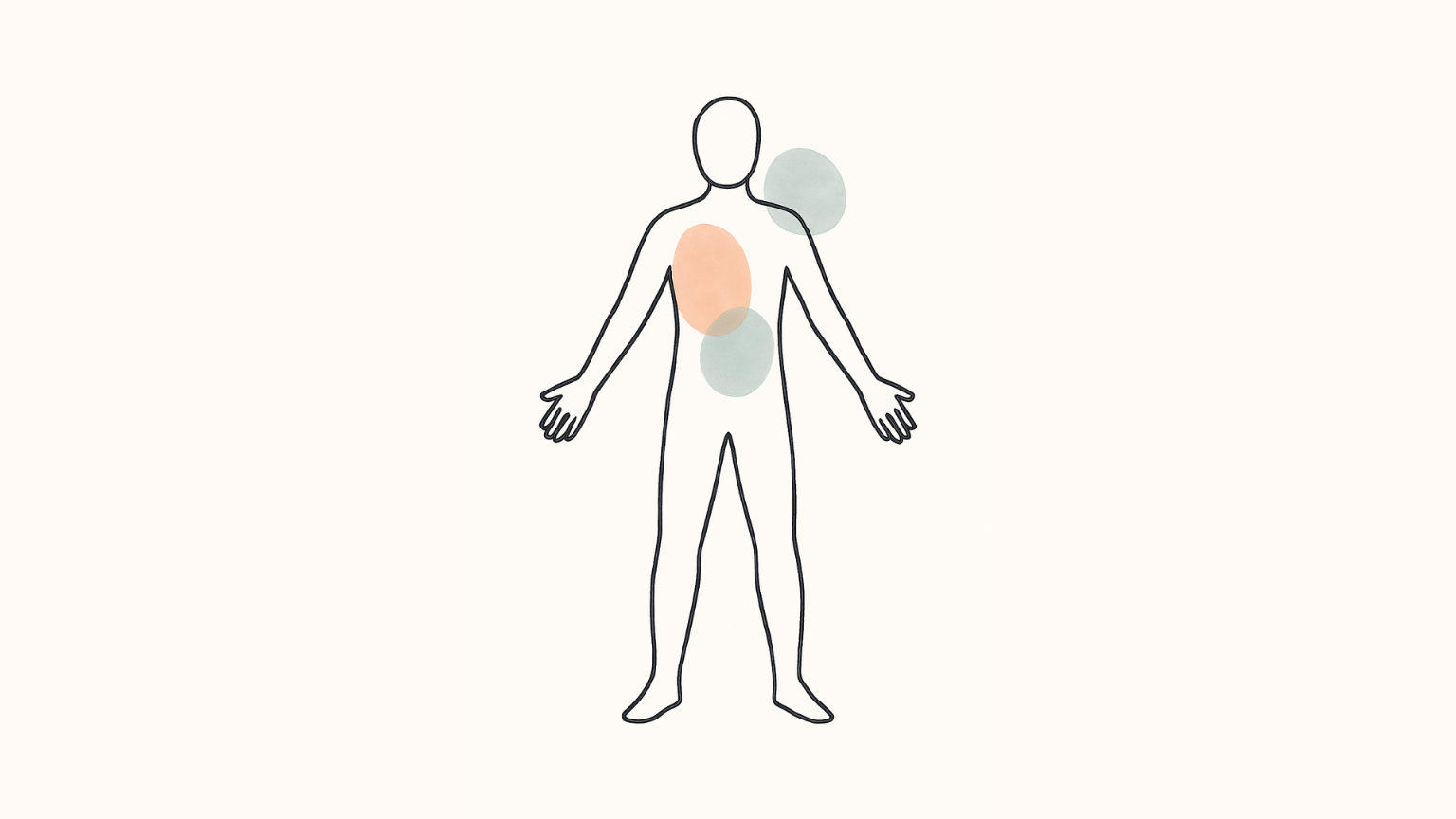
How anxiety lives in the body, and the ways we can soften or even shift it
Anxiety is Your Personal Internal Alarm System
When anxiety hits, it doesn’t always just stay in your head — often times, it’s in your body.
Racing heart. Shaky hands. Tight chest. Sore jaw. Upset stomach. A kind of full-body buzz that says: “Something’s wrong.”
It makes sense — anxiety is your body’s alarm system. It evolved to keep you safe. And when your brain thinks there’s a threat (even if the threat is just a thought), your body kicks into fight, flight, or freeze.
That might mean:
- Tension in your muscles (ready to run or brace)
- Faster breathing and heart rate (pumping oxygen to limbs)
- Sweaty palms (grip and cool down)
- Tunnel vision or dizziness (focusing in on danger)
So no, you’re not broken — this is your body trying to protect you.
The issue is that it’s doing it a bit too often, or in moments that don’t actually require protection.
It’s Often Hard to Think Your Way Out of a Physical Stress Response
When your body is fired up, logic may not land so well.
You might know you’re not in danger, but still feel totally on edge.
That’s because the “thinking brain” tends to go quiet when anxiety spikes — while the body goes into high alert.
In those moments, it helps to try a bottom-up approach — working with the body to send signals of safety, rather than trying to talk yourself down with reason alone.
Just to give you a flavour, here are a few simple, body-based tools I often explore with clients — the kind that can help shift your nervous system out of overdrive.
Breathing That Calms
Breathing is one of the simplest and most effective tools we have.
Here are two tried-and-true techniques I often share with clients:
Box Breathing (Square Breathing)
- Inhale for 4 seconds
- Hold for 4 seconds
- Exhale for 4 seconds
- Hold for 4 seconds
- …repeat
You can visualise a square or trace it in your mind as you go around the “sides.”
It’s simple, grounding, and easy to remember.
4-7-8 Breathing
- Inhale for 4 seconds
- Hold for 7 seconds
- Exhale for 8 seconds
This one’s great for winding down, especially at night — longer exhales help activate the parasympathetic nervous system — the “rest and digest” part of your body’s wiring.
You don’t have to do breathing exercises “perfectly”, and you can feel free to adjust some of the timings to suit your comfort levels.
It’s less about the exact numbers, and more about giving your body a chance to slow down and reset.
Progressive Muscle Relaxation (PMR)
Anxiety often shows up as chronic muscle tension — clenched jaws, hunched shoulders, fists, tight legs.
Over time, that tension becomes the new normal, and we forget what relaxed even feels like.
PMR is a technique where you gently tense and then release different muscle groups in sequence — working from head to toe or vice versa.
For example: Clench your fists tight for 5 seconds, then slowly release.
Notice the difference between the tension and the letting go.
This is a great way to retrain your awareness to notice the difference between ‘tight’ and ‘relaxed’ muscles. It also taps into what’s sometimes called the pendulum theory — the idea that by intentionally tensing a muscle first, you create a kind of swing effect: the muscle naturally rebounds into deeper relaxation after you let go.
It’s a simple but powerful way to guide your body out of a wound-up state.
If you suspect you carry a lot of tension in your body, PMR could well be something worth trying — there are plenty of guided PMR audio tracks available online which can be a great place to start.
Grounding Through the Senses
Another body-based way to settle anxiety is through sensory grounding — using your five senses to anchor you in the here and now.
One well-known technique is the 5-4-3-2-1 method:
5-4-3-2-1 Grounding Technique
Concentrate on the present moment; yourself and your present surroundings. In your own time, see if you can name…
- 5 things you can see
- 4 things you can touch
- 3 things you can hear
- 2 things you can smell
- 1 thing you can taste
This works by pulling your attention away from the mental spiral and back into your environment — reminding your brain that right now, you’re okay.
Even just noticing the feeling of your feet on the ground or the temperature of the air can be enough to break the cycle.
Gentle Movement to Reset
Anxiety often tells us to freeze — or sit and stew. But movement can be one of the most effective ways to shake off nervous energy.
This doesn’t have to mean a full-on exercise routine — even light, conscious movement can do the trick:
- Stretching or yoga
- Taking a short walk outside
- Shaking out your arms or legs
- Rolling your shoulders
- Dancing to one song
The point here is, you’re sending your body the message: “We’re not stuck. We’re safe. We can move.”
Bottom Line
Anxiety might start in the mind, but it lives in the body.
And when your body gets the memo that it’s safe, things can start to feel a little easier.
So no — you can’t always logic your way out of a spiral.
But you can breathe. You can move. You can unclench. You can slow down.
And that’s where things often start to shift.


