
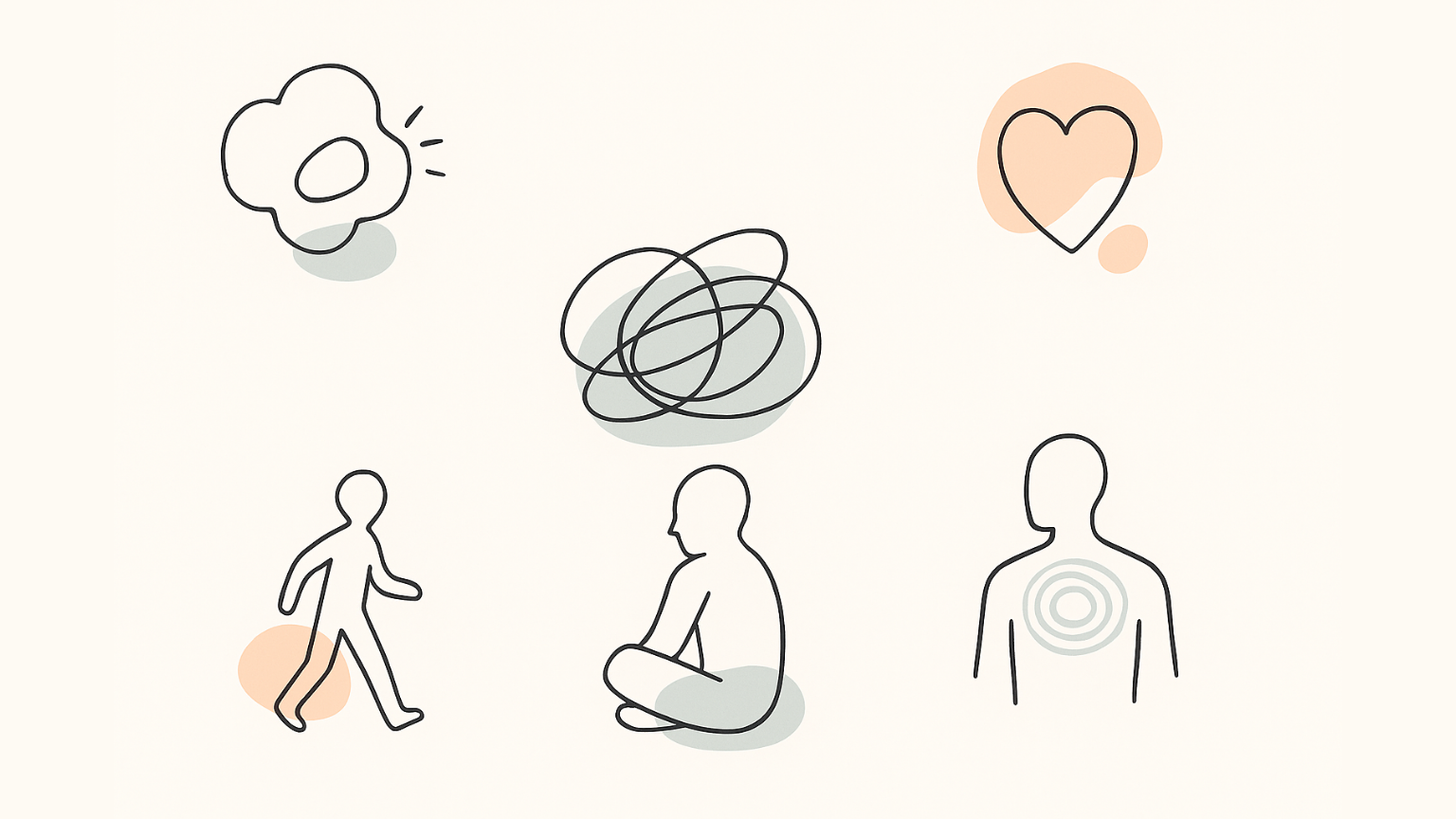
An overview of four key areas where anxiety resides – and can be worked on in therapy.
We meet your anxiety where it is
If you’ve ever felt anxious, chances are you’ve heard some well-meaning advice:
“Just breathe.”
“Think positive.”
“Try yoga!”
And maybe you’ve tried some of it — and found that while some things help, others don’t even seem to scratch the surface.
That’s because anxiety isn’t one dimensional – and neither are the ways we work with it.
We often think of anxiety as a problem to get rid of. But anxiety is actually a built-in safety system, designed to protect us.
It’s the adrenaline surge when you step into a road and hear a car coming. It’s what helps you slam the brakes, jump out of the way, or speak up when something’s not okay.
In other words — anxiety can be useful. The goal isn’t to eliminate it completely (and even if we could, that wouldn’t actually be in your best interest). The goal is to understand how it works, and learn how to respond in ways that help you move forward, instead of getting stuck.
Anxiety shows up differently for different people.
For some, it’s an endless loop of ‘what-ifs’ and worst-case scenarios.
For others, it’s a racing heart, a knotted stomach, or a strong urge to avoid.
And for many, it’s all of the above — a mix of anxious thoughts, uncomfortable feelings, physical tension, and habits that keep the cycle going.
In therapy, I often talk with clients about anxiety using these four key areas — or paths — where we can intervene:
- Thoughts – how we work with anxious thinking
- Emotions – how we sit with difficult feelings
- Actions – what we choose to do (or avoid)
- Body – how we respond to anxiety physically
Each of these domains gives us a slightly different entry point. You don’t need to “work on everything” all at once…
In fact, if we can shift things in just one of these areas, we often start to soften the hold anxiety has on us. Sometimes, a small change in one domain can interrupt the whole loop.
That’s why I often say to clients:
“There are lots of ways we can approach anxiety. Let’s figure out what actually fits for you.”
This page serves as an introduction for the Making Sense of Anxiety (In Therapy) series — a set of informative posts designed to give you a clearer picture of what anxiety work can look like in therapy (or on your own).
If you’re already working on your anxiety in therapy — or thinking about starting — this series may help to give you a sense of the kinds of things we can focus on together.
And if you’re working on your own, hopefully this can serve as a reminder that you have more tools — and more choice — than it sometimes feels.


