
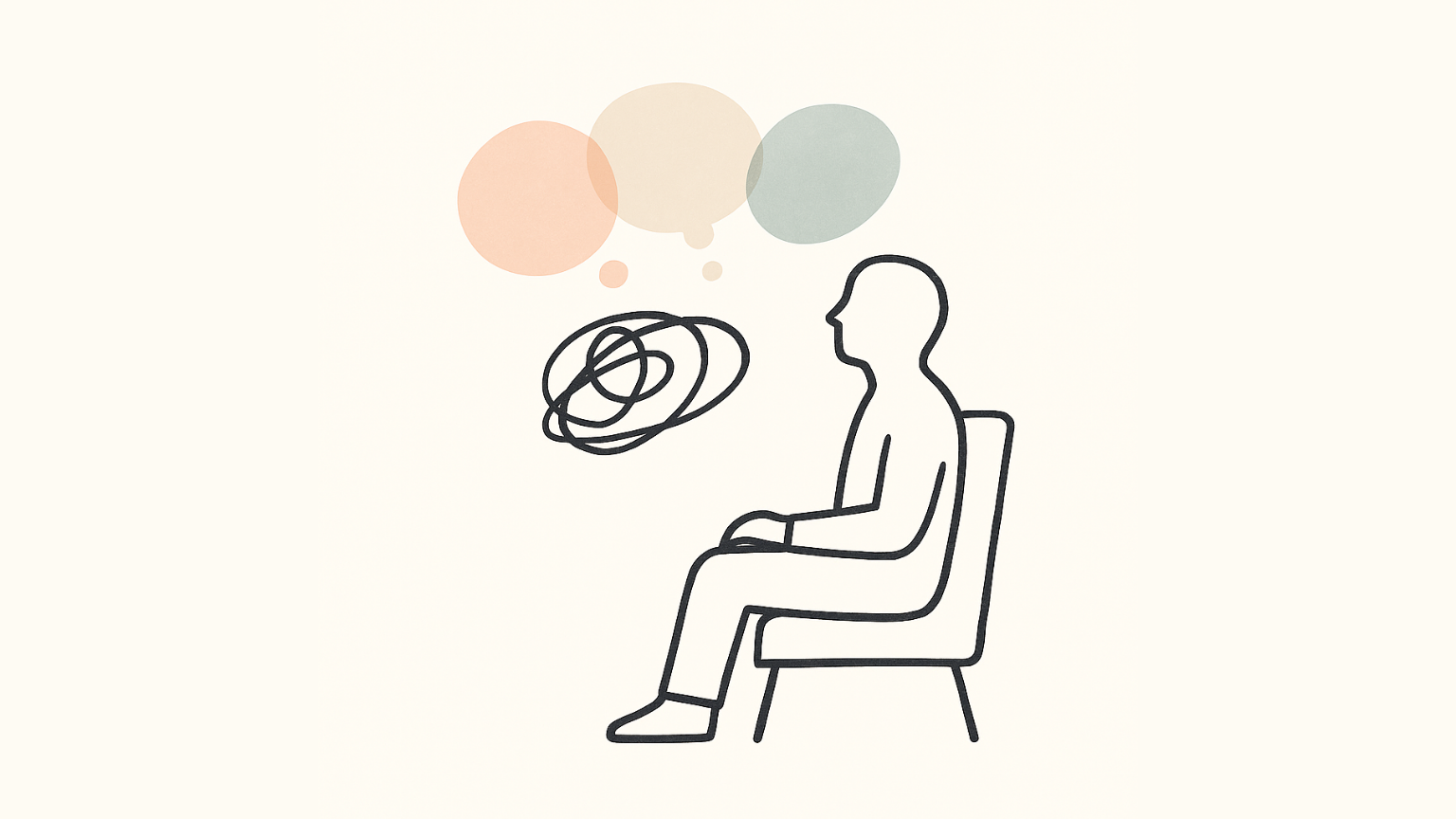
Exploring ways to challenge anxious thoughts and how we might improve our relationship with them.
Anxiety often starts in the mind…
When anxiety kicks in, the mind often goes into overdrive.
What if this happens? What if that goes wrong? What if I can’t cope?
And just like that, we’re not responding to what’s happening now — we’re mentally time-traveling into an imagined future; reacting to all the possible disasters our brains can come up with.
And while anxious thoughts might feel automatic, repetitive, or completely out of our control, how we respond is absolutely within our control.
In this section, we’ll look at two main ways we can work with anxious thinking:
- Challenging the thought itself (What’s the evidence? Is this helpful?)
- Changing how we relate to the thought (Letting it be there without getting pulled in)
Both approaches can be effective — and many people find that a mix of the two is most helpful. The goal isn’t to win an argument with your anxiety. It’s to step out of the loop it keeps dragging you into.
1. Challenging Thoughts
Not every anxious thought is true — but they do tend to feel convincing. That’s because the anxious brain is constantly scanning for problems, then throwing out predictions, warnings, or worst-case scenarios in an attempt to protect us.
Sometimes those thoughts are based on past experiences:
“Last time I did this, it went badly… it’ll probably go badly again.”
Which brings me to one of my favourite sayings from Cognitive Behavioural Therapy (CBT):
“The past doesn’t equal the future.”
The Brain Loves Shortcuts (Even When They’re Unhelpful)
The brain is wired to learn from danger. So if something once felt threatening — even if it wasn’t — your mind stores that information and starts looking for anything remotely similar. These mental shortcuts can be helpful in genuinely risky situations, but they often backfire with anxiety.
Your mind might shout:
“Don’t go — this feels the same as last time.”
But that “sameness” is often based on emotional memory, not fact.
That’s why we work on challenging the story the mind is telling, especially when it’s based on assumptions, generalisations, or old wiring.
The anxious brain operates on a better safe than sorry logic — if you feel anxious, your mind assumes there must be a threat. So it starts scanning: What’s wrong? What am I missing? Even if there’s no real danger, the brain doesn’t like uncertainty — and the search itself can keep us stuck in the loop.
Common Thought Patterns That Keep Anxiety Going
These are often called cognitive distortions — or ‘unhelpful thinking styles’. They’re automatic thought habits that tend to show up when we’re feeling stressed, anxious, or overwhelmed. They’re not a sign that something’s wrong with you — they’re just the brain’s way of trying to quickly interpret what’s happening.
In fact, a good rule of thumb is:
If you’re feeling something strongly — whether it’s anxiety, guilt, or fear — there’s often a distortion at play underneath.
Some typical cognitive distortions we might explore in therapy include:
- Catastrophising – jumping to the worst-case scenario
- Mind reading – assuming we know what others are thinking
- Fortune-telling – predicting the future as if it’s fact
- Black-and-white thinking – “If I don’t do it perfectly, I’ve failed”
These thought patterns often lead to stuck behavioural loops — like overthinking every decision, asking for repeated reassurance, avoiding things altogether, or checking for signs of danger again and again.
The tricky part? These thoughts often feel like they’re helping — like they’re keeping us safe, prepared, or in control. But more often than not, they’re just draining our energy and fuelling the anxiety loop.
Socratic Questioning: Getting Curious Instead of Getting Stuck
When we challenge anxious thoughts, we’re not trying to “think positive” or fake confidence. It’s not about swapping a “bad thought” for a “good one” — it’s about asking better questions that open things up instead of tightening the spiral.
Some people think of this as “putting their thoughts on trial.”
That means looking at all sides: the evidence for and against it, the alternative explanations, the missing context. We’re not pretending everything’s fine — we’re just making space for the idea that things might be more balanced, more complex, or less catastrophic than they first appeared.
Some questions we might explore include:
- What’s the evidence for and against this thought?
- Is this thought true — or just familiar?
- Am I reacting to a feeling, or a fact?
- If a friend had this thought, what would I say to them?
You might notice that anxious thoughts often come from deeper fears or beliefs — like “I’ll mess it up,” “I can’t cope,” or “I’m not good enough.” These core beliefs can quietly shape the way we interpret events. Part of the work is gently noticing when a surface-level thought might be tied to something deeper — without needing to solve everything all at once.
A Note on Control
One powerful way to defuse anxious thinking is to ask:
Is this something I can control, influence, or neither?
Sometimes anxious thoughts pull us into scenarios we can’t do anything about. If a worry sits outside your sphere of control, the most helpful move might not be solving it — but noticing it, and shifting focus to something you can act on.
Bottom Line
Challenging thoughts isn’t about arguing with yourself or trying to erase anxiety. It’s about learning to pause — to notice what your mind is doing, and to check whether that story is actually helping.
You don’t need to believe every thought. You just need enough distance from it to decide what to do next.
2. Letting Thoughts Be
Some anxious thoughts don’t need to be challenged.
They need to be noticed — and left alone.
That might sound strange, especially if you’re used to trying to fight off every worry or reframe every spiral. But sometimes, the most helpful move is to let the thought be there without reacting to it, believing it, or getting into a debate.
Your Brain Means Well (Even When It’s Loud)
Anxiety often comes from a protective place. Your brain is trying to help you avoid danger — physical, social, emotional, or imagined. It’s working hard to keep you safe, even if it’s overfiring or misreading the situation.
This is where a simple mindset shift can be powerful:
“Thank you, brain, for looking out for me. But I’ve got this.”
You’re not ignoring the thought — you’re acknowledging it with kindness and choosing not to give it the microphone.
This approach is sometimes called cognitive defusion — learning to notice a thought as just a thought, not a truth, and not a command.
It can help to play with the thought a little — to take it less seriously. Some examples people find useful:
- Passengers on the Bus – Imagine your thoughts as noisy passengers, shouting directions while you’re driving. You don’t have to argue with them — and you’re not about to kick them off — but you can choose not to take their advice. Just keep driving.
- Silly Voice Technique – Repeat the thought in a cartoon voice (think: your inner critic sounding like Homer Simpson).
- Pop-up Windows – Picture your thoughts as annoying browser pop-ups. Click the little cross and keep going.
- Change the Font – Visualise the thought written in sparkly bubble letters, Comic Sans, or rainbow colours — just enough to shift how seriously you take it.
These may sound a little ridiculous — but that’s the point. You’re loosening the grip.
When a thought loses its authority, it loses its hold.
Giving Thoughts Space (Mindfulness, Observation & Reframing)
It can feel natural to try and “solve” every anxious thought the moment it appears. But that often just feeds the cycle — it sends the message that this thought must be important, or dangerous, or urgent.
Mindfulness teaches a different approach:
Noticing the thought, without needing to respond to it.
That doesn’t mean ignoring it or pushing it away. It means observing it as a mental event — like a cloud drifting by, a pop-up notification, or background noise. Something you can notice… without needing to act.
You might catch yourself thinking:
- “There’s that same old worry again.”
- “My mind is doing that thing it does when I’m tired.”
- “Ah, here comes the ‘what if’ voice.”
That kind of awareness is the whole point.
It creates space between you and the thought — and in that space, you get choice.
You might find it helpful to shift how you talk to yourself when thoughts show up. Here are some phrases that can help change your internal tone:
- “My mind’s having a thought right now.”
- “Just because it feels urgent doesn’t mean it is.”
- “This is just a story my anxiety tells me.”
- “Thanks, brain. Noted.”
These kinds of responses can feel a bit odd at first — especially if you’re used to debating or resisting your thoughts. But with practice, they reinforce a simple but powerful message:
You are not your thoughts. You’re the one observing them.
You don’t need to be in a meditation retreat to start building this skill. A few minutes of mindfulness practice each day — even just noticing your breath, or tuning in while walking or making a cup of tea — can start to change how you relate to your thoughts.
I often signpost clients to some of the many excellent guided audio meditations available online — short, approachable sessions that talk you through exactly what to do. Even five minutes a day can make a noticeable difference in how reactive (or not) the mind feels.
Bottom Line
You don’t always need to challenge, debate, or fix an anxious thought. Sometimes, just noticing it — without judgment or urgency — is enough to lessen its power.
By creating a little space, you remind yourself:
“I’m still here. And I’m in charge of what I do next.”


